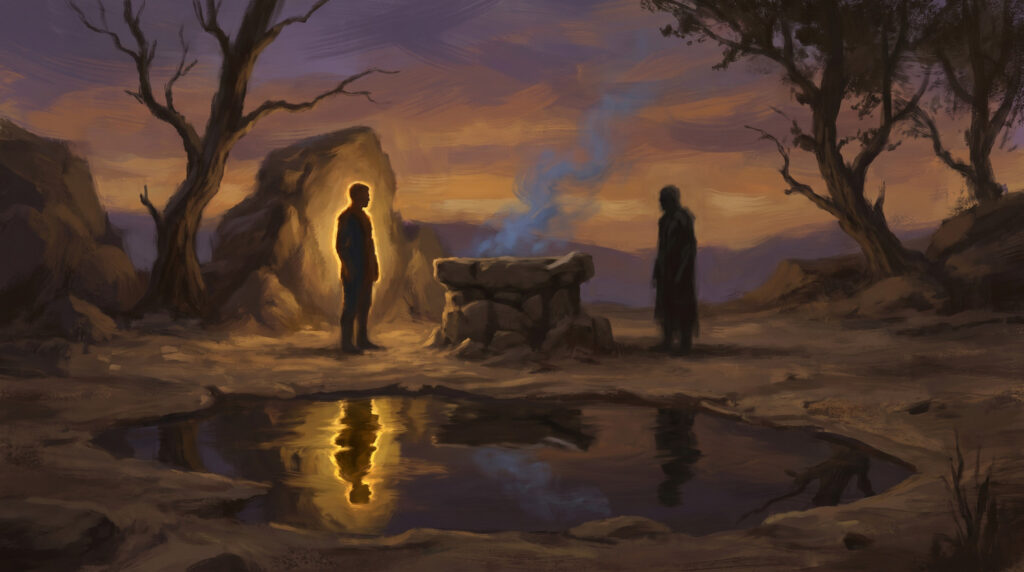
The second story: when attack enters the dream
Soul4you · Georgina Kovacs · One Dream, Part 2
In the first reflection, we paused at Adam’s sleep. Genesis describes that sleep without explicitly narrating his awakening; A Course in Miracles takes up this silence as part of its account of separation. (Genesis 2:21–25; A Course in Miracles, T-2.I.3)
Within the inward reading of this series, the stories that follow unfold inside that dream. We now turn to Cain and Abel, after the garden and the eating of the fruit, to ask what happens when the experience of separation becomes attack.
Two brothers bring offerings; one offering is accepted and the other is not. Cain becomes angry, and later kills Abel. (Genesis 4:3–8) What might this scene reveal when I read the brothers as two movements within a single mind?
I am not replacing the story’s concern with a murdered brother, or dismissing its religious and ethical meanings. I am exploring another question alongside them: what do I turn against when I cannot bear what another person seems to reveal about me?
What the Hebrew names open
The name Cain, Qayin, is linked in Genesis 4:1 through wordplay with qanah, a verb associated with acquiring; the lexical sources distinguish this narrative association from the wider question of the name’s origin. (Strong’s H7014 and Brown–Driver–Briggs) For my reading, that association opens an image of grasping, acquiring and keeping account.
Abel’s Hebrew name, Hebel, is commonly associated with hevel, the word for breath or vapour, although the lexicons do not agree completely about its derivation: Strong’s connects the forms, while Brown–Driver–Briggs questions that derivation. (Strong’s H1893 and Brown–Driver–Briggs; hevel, H1892) I take the image of breath as a symbolic opening, not as an etymology that settles the character’s meaning.
In the inward map I am drawing, one movement grasps. The other cannot be held in a closed hand.
This does not mean that acquiring something is wrong, or that working the land makes Cain spiritually inferior to a shepherd. The contrast I am interested in concerns the relationship I form with what I give, receive and believe I deserve.
Do I offer something freely? Or does my gift carry an unspoken demand that someone must now confirm my worth?
The narrative tells us about Cain’s anger and God’s warning before the killing, but it does not provide a full account of Cain’s inner reasoning. (Genesis 4:5–8) That leaves room for interpretation, not permission to claim certainty about every motive.
Nor does explaining a possible motive justify the act. An inward reading should make responsibility clearer, not make a harmed person disappear.
A single mind, and the belief in division
A Course in Miracles offers a sentence that stands at the centre of this reflection:
“You cannot perpetuate an illusion about another without perpetuating it about yourself.” (A Course in Miracles, T-7.VIII.4)
The paragraph goes on to insist that mind cannot be fragmented; it is the belief that it can be attacked or divided that underlies the ego’s use of projection. (A Course in Miracles, T-7.VIII.4) Here, ego means the Course’s thought system of separation, not a diagnosis of a person’s character.
In my own words, I hear this: when I make another person the container for everything I refuse to recognise, I strengthen the boundary I believe exists between us. I defend an image of myself by condemning an image of them.
Within this metaphysical framework, the mind does not actually become several minds. The experience of division deepens.
This is how I read Cain and Abel as a single sleeping mind turning against itself. The one who grasps tries to silence what cannot be possessed.
That image does not mean that every judgement I make about another person’s behaviour is false. It asks me to look honestly at the part played by my interpretation, without denying what someone has actually done.
The Course then asks the reader to accept responsibility for errors without holding on to them, and to give them to the Holy Spirit for correction. (A Course in Miracles, T-7.VIII.5) Responsibility, in the way I bring this into daily life, is not an instruction to hate myself more accurately.
It is an opening. I can stop defending a response simply because it has become familiar.
Two offerings, two inner voices
Cain brings an offering from the produce of the ground; Abel brings the fatty portion of the firstlings of his flock. Genesis says that God looks favourably on Abel and his offering, but not on Cain and his offering, without stating the reason for that difference. (Genesis 4:3–5 and note on 4:4)
I therefore do not take the passage as proof that Cain’s gift was inferior or that we can read his attitude directly from its contents. Instead, I use the contrast to ask a question about giving.
What happens when an offering becomes a test of whether I matter? What happens when someone else’s acceptance feels like my rejection?
The two voices described in A Course in Miracles give me a way to explore that question. The Course distinguishes a voice we have made from a voice given by God, and asks us to choose which to hear. (A Course in Miracles, T-5.II.3)
In the symbolic language of this article, I call the first movement Cain: the part of me that compares, keeps score and tries to secure its value. I call the second Abel: the willingness to offer without making love dependent on a particular response.
These correspondences are my reading of the brothers. They are not names the Course assigns to its two voices, and I am using “voice” for an inward orientation rather than an audible sound.
The Cain movement can feel threatened even before anything has been taken away. Someone else is welcomed, and I hear: there is less room for me.
The question is not whether I can force that feeling to disappear. It is whether I have to obey the conclusion I draw from it.
Before the murder, God addresses Cain’s anger and speaks of sin crouching at the door, urging him to master it. (Genesis 4:6–7) The Hebrew form rovetz comes from rabats, a verb used for lying or crouching, including both resting domestic animals and wild animals in their lairs. (Strong’s H7257 and Brown–Driver–Briggs)
The word alone does not turn the image into something harmless. What matters to my reading is the threshold: a feeling is present, but a deed has not yet followed.
There is a space in which another response remains possible. That is where I want to pause.
The logic of attack
In its account of projection, the Course describes disowning something in oneself, attributing it outwardly and using the apparent difference to maintain separation. (A Course in Miracles, T-6.II.1–3) I place that pattern beside Cain’s story.
The following sequence is my reconstruction of an inward movement, not a psychological report supplied by Genesis:
- I feel a lack: perhaps I am not enough, perhaps I do not matter.
- Rather than look at that fear, I search for what seems to have caused it.
- Another person becomes the explanation: the problem is their presence, their gift, their acceptance.
- I imagine that removing or diminishing them will restore my peace.
But breaking the mirror does not resolve the judgement I brought to it. I may silence the reminder while leaving the fear untouched.
After the killing, God asks where Abel is, and Cain responds by denying knowledge and questioning his responsibility as his brother’s keeper. (Genesis 4:9) For me, this is the dream’s next movement: first I separate myself from the other, then I try to separate myself from what I have done.
The alternative is not a blanket confession that everything is my fault. It is the more precise question: what is mine to acknowledge, and what can I now choose differently?
If I have caused harm, responsibility may include stopping, telling the truth, apologising and making amends. If I have been harmed, responsibility for my next step does not make me the cause of another person’s actions.
I can examine my own interpretation while recognising a real boundary. The two do not cancel each other.
The mark that interrupts retaliation
Cain fears that someone will kill him, and God gives him a protective mark. The verse does not describe the mark’s appearance or place it on his forehead. (Genesis 4:13–15)
This protection does not erase Abel’s death or remove the consequences described in the story. Cain is still confronted with what he has done and leaves the Lord’s presence. (Genesis 4:10–16)
Yet retaliation is interrupted. To me, that is the detail in which the possibility of grace becomes visible.
I read the mark as saying: even this person cannot simply be discarded from the whole. Condemning the act does not require making vengeance the final word about the person.
The Course rejects the idea that God seeks retaliation and contrasts Atonement with sacrifice. (A Course in Miracles, T-3.I) In its account of Atonement, the correction leads towards recognition that separation never occurred. (A Course in Miracles, T-6.II.10)
I use Atonement here in that particular sense: the undoing of the belief in separation. I am not using it to mean a punishment that must be endured before love becomes available.
Nor does this make repair unnecessary. In daily life, correcting an error asks something of how I behave, not only of how I describe myself spiritually.
The mark becomes an image I can carry without drawing it on anyone’s body. I can refuse to dehumanise someone while also refusing to give them access to harm me.
Three ways to work with the story
These are invitations to reflection, not tests of spiritual progress. Choose an ordinary situation in which you feel safe enough to be curious; there is no need to begin with your most painful experience.
Notice which movement you are following
When comparison or resentment appears, pause and ask: what am I afraid this says about me? Am I looking for understanding, or for evidence that someone else must be diminished?
You might write: “When this happened, I felt…” and then: “The meaning I gave it was…” Keep the event and the interpretation separate.
If you recognise a familiar judgement in yourself, notice it without turning the exercise into an accusation. If you do not recognise it, you do not have to invent a hidden fault to make the metaphor work.
Take back only what belongs to you
Ask: what did I choose here, and what can I choose now? Perhaps you need to acknowledge a sharp remark, clarify a misunderstanding or stop measuring your value against someone else’s response.
Perhaps the next step is a boundary, practical support or leaving a harmful situation. Taking responsibility does not require saying that you caused what was done to you.
When you give your time or attention, you can also ask: am I offering freely, or asking this gift to prove that I deserve love? Give only what you can honestly offer; generosity does not require abandoning your own needs.
Let protection mean something
Think of the mark as a pause in the chain of retaliation. Is there someone you have reduced entirely to a mistake, a disagreement or a role?
If it is safe and appropriate, a small act of repair may be possible. It may also be enough, for now, to stop rehearsing contempt while keeping a necessary distance.
You do not have to send a message, resume contact or restore trust to practise this reflection. Recognising shared humanity and maintaining protection can belong to the same choice.
The story that continues
In this series, Adam’s sleep opens the image of experienced separation. Cain and Abel bring us to the point where that experience seeks to defend itself through attack.
My central question is not which brother is “the bad one” inside me. It is whether I can notice the moment when my fear begins to demand that another person pay for it.
In the next reflection, we will turn to the flood and the longing to wash an inner world clean. Before moving on, I would like to leave three questions here:
- Where have I treated another person’s acceptance as evidence of my own rejection?
- What is genuinely mine to acknowledge, without taking responsibility for what belongs to someone else?
- Can I interrupt retaliation without giving up the boundary I need?
The quieter movement does not have to win an argument. It needs a little room to be heard.
With love,
Georgina
Soul4you