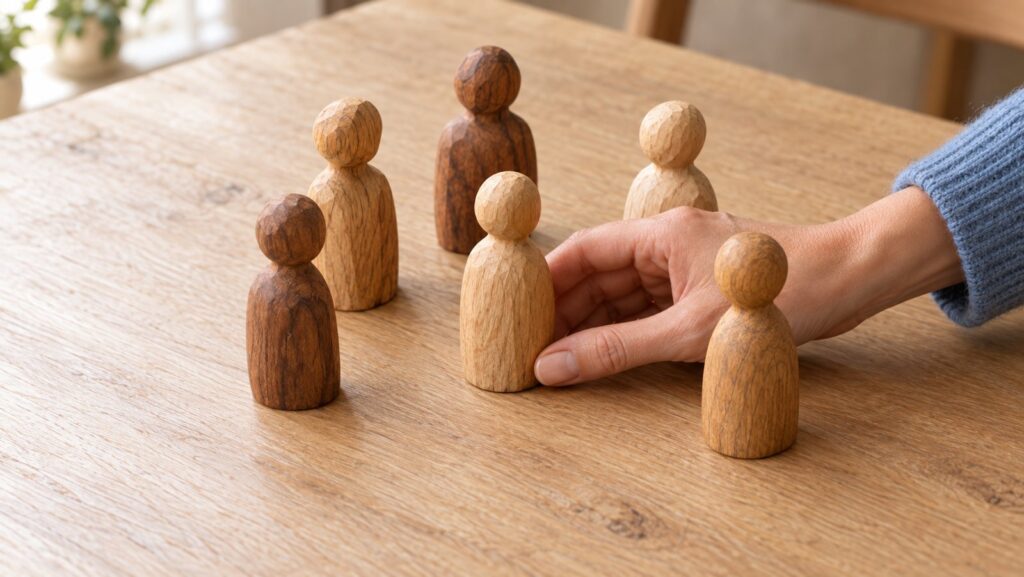
When family constellation work helps, and when its explanation begins to confine us
This essay offers my own perspective, not a research report or a therapeutic guide. I distinguish research findings, the claims made within a method, and my metaphysical understanding, because a useful experience does not automatically establish the explanation attached to it.
What if a recurring family question has not remained unresolved because you have failed to go deep enough? What if you are asking one framework to answer something it cannot settle for you?
I want to examine two ideas that can become entangled: that family relationships reveal something about us, and that the unresolved fate of our family determines who we must become. They are not the same statement.
This is not an attempt to dismiss the value someone has found in family constellation work. It is a question about the relationship between a tool, the account it offers, and the freedom to continue beyond that account.
Different questions need different kinds of answer
When I speak metaphysically about family, I am asking about the soul’s relationship with the circumstances of a life. I believe that the soul’s arrival in a particular environment carries meaning beyond what can be described through family history alone.
A psychological question is different. It asks, for example, how experiences, relationships, learning and biological predispositions may have influenced the way a person responds.
The claim that someone unknowingly carries an ancestor’s unresolved fate is different again. It belongs to a particular explanatory model, rather than standing for psychology or psychotherapy as a whole.
These accounts can be placed in conversation, but they should not be silently substituted for one another. A felt recognition in a constellation does not, by itself, identify a biological mechanism, establish an unknown historical event or prove a soul’s intention.
For a long time, I found the combined statement persuasive: I had received my family’s inherited burdens because they reflected me. It sounded complete.
Now I am more interested in where the apparent completeness conceals a change of question. Am I discussing a learned response, a family event, a therapeutic experience or a metaphysical belief?
If I expect one answer to cover all of them, I may remain attached to a framework long after it has stopped helping me. Worse, I may decide that my lack of progress proves something is wrong with me.
Not only a mirror: an encounter
A familiar version of the mirror idea says that whatever troubles me in another person must also be present in me. I do not accept that as a universal rule.
Sometimes another person helps me notice something I have not wanted to see in myself. Sometimes I am accurately noticing conduct that is harmful, and the responsible response is not to search for the same fault within me.
The question needs to remain open long enough to meet the actual situation. An automatic rule has already decided the answer.
My own image is of two points of light meeting. As two people speak, act and respond, something moves between them.
For me, this image expresses an energetic interaction, not merely a metaphor for a change of mood. I understand an encounter as capable of revealing different degrees or expressions of a quality in each person, with a possibility of movement towards balance.
That is how I see it; it is not a universal mechanism established by research. Nor can I infer the meaning of another person’s relationship without listening to them.
When the image is useful, I ask: what might this meeting reveal about how each of us carries a particular quality? Where might a movement towards balance be possible?
That question is most appropriate where there is enough safety, freedom and reciprocity to explore it. It should not be used to call domination a necessary balancing of energies.
An imbalance of power is not the same as an exchange of qualities. A child is not equally responsible with an adult for what happens in their relationship, and abuse does not become mutual simply because two people are involved.
Nor does a meaningful encounter have to end in continued closeness. Something may become clearer, and the appropriate next step may still be distance.
The unsolicited mirror
There are two misuses of the mirror image that I want to avoid. One turns every uncomfortable encounter into a verdict against the self; the other turns an opinion about someone into an authority they did not ask us to assume.
“What is wrong with me that I see this?” is already a loaded question. It leaves little room for the possibility that I am seeing something accurately.
“I am only holding up a mirror” can be equally limiting when used to deliver an unsolicited judgement. Calling the judgement a mirror does not make it neutral or oblige the other person to accept it.
For me, the value of the image lies in enquiry rather than power. It should help us listen more carefully, not give us a privileged position from which to define another person.
That distinction becomes especially important in families, where roles, dependence and long histories may make a simple “two-way relationship” description inadequate. An honest reflection must leave those differences visible.
A pause before the metaphysical question
I believe the soul does not arrive in a life without meaning. But I do not believe this gives me permission to tell a person who has been harmed that they chose the harm or needed it.
No point in someone’s recovery makes such a declaration mine to impose. A spiritual account must remain an invitation they can decline.
What matters first is that the person can name what happened and receive appropriate support. Responsibility needs to be placed with those responsible, rather than distributed through a spiritual explanation until it becomes impossible to locate.
For some people, a metaphysical question may later become meaningful. For others, it may never be helpful, and that does not indicate a failure to grow.
Pain is not evidence that someone has failed to reach a sufficiently spiritual perspective. A person can hold deep faith and still grieve, feel anger or live with the effects of trauma.
If the discussion of the soul below feels intrusive, you can leave it. The practical reflections later in this essay do not depend on accepting my metaphysics.
Family as a setting for the soul’s learning
My own view is that a family can be part of the environment through which the soul encounters what it has come to learn. I do not mean that biological descent disappears, or that ordinary causes cease to matter.
I am addressing another level of meaning. Alongside the question “How did these relationships shape me?”, I ask “How can I inhabit this life without making that shaping the final limit of who I am?”
This is the freedom I seek. Not freedom from acknowledging my history, but freedom from treating history as an unalterable sentence.
I find it helpful to distinguish two positions without claiming that they represent every practitioner or every family:
- An account that closes the future: What my family did has already decided what I can be.
- An account that leaves room: My family has influenced me, sometimes deeply, but my life is not exhausted by those influences.
The second position is compatible with acknowledging genuine harm. A parent may be causally and morally responsible for something that happened; seeing my life as meaningful does not remove that responsibility.
When I describe relatives as fellow travellers, I mean that their lives are not reducible to the burdens I associate with them. I do not mean that I owe continued contact, that they owe no apology or repair, or that practical and legal duties disappear.
The debt I want to stop carrying is a metaphysical one: the idea that I must resolve another person’s whole existence before I am entitled to live my own. That is different from asking someone to take responsibility for what they have actually done.
Even where two people seem to encounter a similar question, their paths are not the same. I cannot derive the meaning of my life from the story I tell about someone else’s.
Learned patterns and what we call inheritance
“Inherited pattern” can refer to several different things: biological predispositions, learned behaviours, repeated relational conditions, material circumstances and meanings passed through a family. Treating them as one mysterious substance can obscure the actual question.
Albert Bandura, Dorothea Ross and Sheila Ross demonstrated that children exposed to aggressive adult models could reproduce similar behaviour later, in a different setting, without direct reinforcement for that imitation. (Bandura, Ross and Ross, 1961) This provides evidence for observational learning, not proof that every family pattern has one cause.
For me, its importance is practical. A response that has been learned is not thereby a permanent definition of the person who learned it.
But I do not want to turn this into another oversimplification. Learning in childhood is not always a conscious choice, and recognising a pattern does not mean that changing it will be immediate or easy.
Research on intergenerational effects of trauma also needs care. Yehuda and Lehrner’s 2018 review distinguishes several possible pathways and emphasises that the strongest controlled evidence then available came from animal models, while human findings could not be attributed to one set of determinants. (Yehuda and Lehrner, 2018)
That does not mean family trauma has no consequences. It means that a specific story about how an ancestor’s experience has reached a particular person needs more support than the general fact that generations can affect one another.
Neither the social-learning experiment nor the epigenetic review establishes that someone literally carries another person’s unresolved fate. Their questions and evidence are different.
I also no longer find the contrast “inherited means external, learned means internal” precise enough. Both biology and experience can become part of how we live, without either becoming the whole of who we are.
The question I can work with is more concrete. What response do I recognise in myself, what may have helped shape it, and what conditions would support a different response now?
There may be consequences of a family history that cannot be changed by decision alone. Support, treatment, safer conditions and time may all matter.
Taking responsibility for my next step is not the same as taking blame for the circumstances that made the step necessary. Agency does not require pretending that I have complete control.
Simultaneous lives: my metaphysical position
Here I move explicitly beyond the research just discussed. I believe that our different lives unfold simultaneously, rather than forming a simple sequence of previous, present and future lives.
I also understand them as energetically related. In my view, what moves within one life can affect the others, not merely as an analogy but as a real relationship within a wider reality.
This is my metaphysical conviction, not a result established by physics or by the studies cited in this essay. By simultaneity, I mean the coexistence of those lives, not a sequence whose connections merely become visible afterwards.
Within this view, I do not understand life’s difficulties through a ledger in which a previous life’s offence must be repaid by present suffering. I speak instead of learning and development.
That rejects a particular reward-and-punishment model in my own thinking. I do not present that model as an adequate definition of every tradition’s teaching on karma, or claim to have disproved those traditions.
I also do not understand the soul as arriving with inherited spiritual guilt. This is another part of my own view, not a conclusion that follows from simultaneity alone.
My account of time cannot, by itself, settle Christian teachings about original sin. Nor should original sin and a supposed debt from another personal life be treated as though they were the same doctrine.
What I can state clearly is where I stand. I do not see the soul as fundamentally condemned; I see it as belonging to the Source and entering experiences through which recognition and change are possible.
I sometimes understand the difficulties of my own life as part of that learning. Yet neither I nor anyone else can infer a person’s spiritual development from the amount of suffering they endure.
A painful situation does not become fair because I later learn from it. And I do not have to be grateful for being harmed in order to be grateful for the strength or understanding I have developed.
These distinctions allow my conviction to remain clear without turning it into a verdict on another person’s experience. You do not have to share it to continue with the practical argument.
What the research on family constellations supports
The review cited here examined twelve studies, representing ten independent samples and 568 participants, and reported statistically significant improvements in nine of those studies. (Konkolÿ Thege and colleagues, 2021) Its authors also stressed that the quantity and overall quality of the evidence were low. (The same systematic review)
Seven included studies considered possible adverse effects, and four reported minor or moderate negative effects in a small proportion of participants, approximately 5–8%, that might have been associated with the intervention. (Konkolÿ Thege and colleagues, 2021) Those figures describe the studies examined, not a guaranteed risk estimate for every form of constellation work.
A randomised trial of 208 adults from the general population reported improved psychological functioning after a three-day seminar compared with a waiting-list control. (Weinhold and colleagues, 2013) A subsequent report on the original intervention group found improvements still present at eight and twelve months. (Hunger and colleagues, 2015)
I read these findings as reasons neither to dismiss every reported benefit nor to promise established treatment effects for every person and condition. This is a bounded account of those studies, not a claim that they settle the whole field.
Most importantly for this essay, an improvement after participation does not establish that an ancestral fate was transferred, that representatives recovered unknown historical facts, or that a spiritual field caused the change. Those are separate claims requiring separate evidence.
This is the distinction I want to retain: an experience can help, while the explanation given for it remains unverified. “Unverified” does not mean “disproved”; it means that the question has not been settled by the evidence being offered.
What the method can offer, and what it cannot settle
In my experience, constellation work can give some people a way to notice a relationship or express something they had difficulty putting into words. I value that possibility without treating every feeling that arises as a factual revelation.
A movement towards or away from another person in a workshop can be meaningful as an experience. It is not, by itself, reliable evidence that a hidden event occurred in a family.
The same distinction applies to loss. A symbolic setting may help someone acknowledge grief, but no one should be promised that a ritual will release all that the body has carried or complete mourning on demand.
I also want to be fair to the method’s own development. Hellinger’s organisation describes later forms of its work in explicitly spiritual terms, including connection with a large spiritual field. (Hellinger Sciencia, account of the method’s development)
It would therefore be inaccurate to claim that all constellation work stays strictly within ordinary family dynamics or never asks metaphysical questions. Some forms clearly do.
My disagreement is not that those questions may be asked. It is that the method cannot establish their answers merely through what happens in a session.
For me, the point of departure comes when an account of ancestral entanglement begins to define what my life must mean. I no longer want every question to lead back to a requirement to resolve someone else’s fate.
This is a limit I recognise in the fit between that explanatory model and my own outlook. It is not a rule that every person must leave the method at a particular stage of development.
A tool can be useful without becoming the authority over the whole journey. Continuing elsewhere need not be a rejection of what it once gave.
The question that restores room
The question “Why this family?” remains spiritually meaningful to me. But the freedom I find in it depends on not using it to deny the more immediate question “What happened here?”
Both can remain present. I may acknowledge the effects of my parents’ actions while also refusing to make those effects the entire horizon of my life.
I do not need to deny that I was a victim of a particular act in order to become an active participant in what follows. Victimhood as a fact and agency in the present are not mutually exclusive.
This is why I would now phrase the movement carefully. My family is part of what has shaped me, but it does not exhaust who I am or decide everything I can become.
A sibling may be someone with whom I learn, but not someone whose harmful conduct I must accept. An ancestor’s unfinished life may affect the family story without becoming a duty I must complete on their behalf.
The change is not from truth to a more comforting fiction. It is from one truth treated as total to a life in which further possibilities are allowed.
What to do with a recurring pattern
If you are considering constellation work, I would approach it as a possible reflective experience rather than a guaranteed treatment or a method for discovering hidden facts. The ability to decline, pause and question an interpretation matters.
I would look for a practitioner who is clear about their qualifications and limits, respects confidentiality and consent, and does not pressure participants into reconciliation. If the concern involves trauma, severe distress or a mental health condition, qualified clinical support should not be displaced by a workshop.
If you have already done this work and the same question returns, repetition does not automatically mean you need another session. Ask what has changed, what has not, and whether a different kind of support would better meet the actual difficulty.
For a manageable pattern, you can also try a small written reflection:
- The response: Name one thing you do, rather than giving your whole family or personality a label.
- Its earlier role: When did that response help, protect or make sense? If you do not know, leave the question open rather than inventing an origin.
- Its present effect: What does it protect now, and what does it cost?
- A different movement: What is one small, realistic response you could practise in a sufficiently safe situation?
You do not have to begin with the most painful experience. The purpose is to make a response more workable, not to uncover a dramatic explanation.
If this brings up more than you can comfortably hold, stop and seek appropriate support. An exercise is not more valuable because it overwhelms you.
What changes when I change?
I used to express this more simply: when I change, my surroundings change. What I now mean is more specific.
My perspective, my responses and the way I participate can change. That may affect a relationship, but it does not compel another person to change with me.
They remain responsible for their own choices. I cannot complete their part by becoming sufficiently patient, loving or spiritually clear.
Even my own change is not total control over my life. Illness, resources, obligations and other people’s actions can limit what is immediately possible.
The freedom I am describing is therefore not omnipotence. It is the recognition of the part that can become mine to work with, together with the willingness to seek help for what cannot be carried alone.
Sometimes that part is a different sentence. Sometimes it is a boundary, a treatment decision, a request for support or a departure.
The threshold of freedom
For me, constellation work can be a bridge. I do not need to deny the value of a bridge in order to recognise that my life is not meant to remain entirely on it.
The sentence towards which I have moved is this: my family is part of where my journey began, but it is not the whole definition of who I am.
This is not a demand for gratitude. It is a change in where I place the centre of my life.
In my own experience, difficulties I once understood only as punishment have also become places of recognition. I do not say that this was easy, or that I have completed it once and for all.
A passage in my work in progress expresses that personal understanding:
“In time, I also came to understand that the lessons in my life are there so that I can grow through them. I may not choose the method, but everything that truly shapes me is for me. It is not happening against me, but working for me, even when, on the surface, it feels difficult or unfair.”
By “lessons” there, I mean the challenges and situations through which I make sense of my own journey, not a course or a prescribed programme. The passage speaks for me; it is not an explanation I place over someone else’s suffering.
Freedom, as I now understand it, does not require the disappearance of every grief or the abandonment of accountability. It means that neither an ancestral story nor a single method has to hold the only permission for me to live.
I can honour what I have learnt, acknowledge what was wrong, and continue. The next step does not have to be another return to the same explanation.
With love,
Georgina
Soul4you