An inner reading of Luke 19
Soul4you · Georgina Kovacs · Spiritual reflections, Part 1 of 3
For years, I thought I understood the story of Zacchaeus and the fig tree. A short, wealthy tax collector climbs a tree, Jesus notices him, and an encounter changes his life.
Then one morning, after meditation, a few details began to hold my attention differently. Why this tree? Why Jericho? And what might the meaning of Zacchaeus’s name bring to a story in which the crowd calls him a sinner?
As I stayed with those questions, an image of initiation began to take shape for me. By initiation, I mean an inward threshold: a change in how a person inhabits their own life.
This is the reading I want to share. It does not replace Luke’s account of an encounter with Jesus, or claim to recover a secret meaning that religious readers have failed to understand.
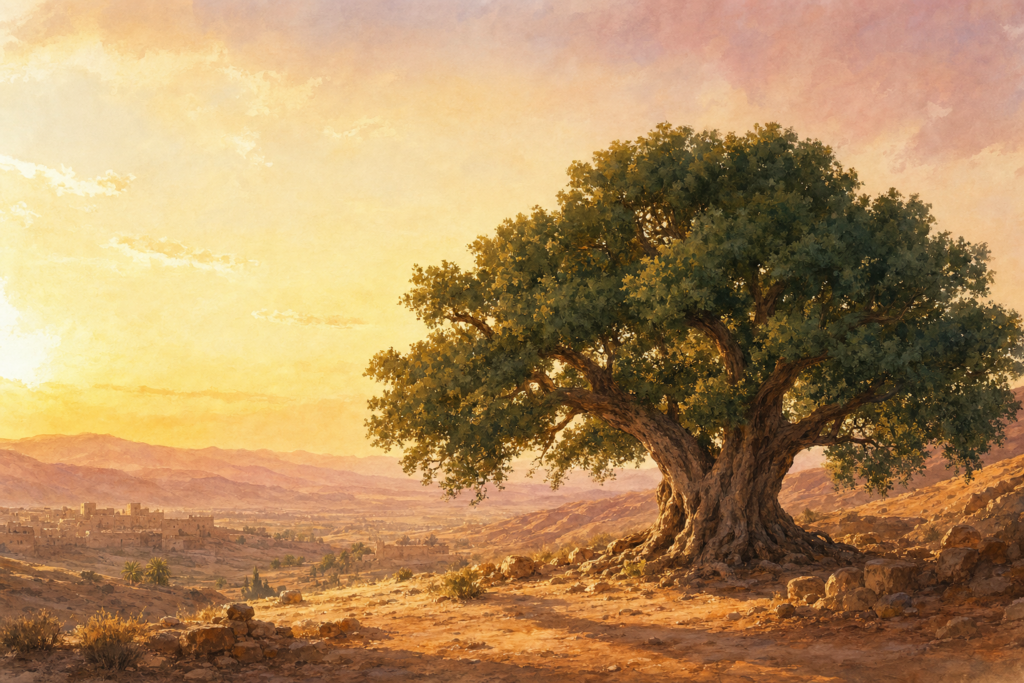
The tree becomes an inner axis in my reflection, an image of gathering oneself and becoming available to an encounter. The connection with Nimrod, the lion and an awakened spine belongs to that symbolic exploration.
The encounter in Luke
Luke describes Zacchaeus as a wealthy chief tax collector who wants to see Jesus but cannot see past the crowd because of his height. (Luke 19:1–3) He runs ahead and climbs a sycamore tree, and Jesus addresses him by name, asking him to come down. (Luke 19:4–5)
The meeting does not remain in the tree: Zacchaeus receives Jesus joyfully, the onlookers object to Jesus staying with a sinner, and Zacchaeus speaks of giving to the poor and making fourfold restitution for any extortion. (Luke 19:6–8) Jesus then declares:
“Today salvation has come to this house because this man too is a descendant of Abraham.” (Luke 19:9, NABRE)
An inward reading should not remove that return to relationship and responsibility. Whatever the tree opens, the story also brings Zacchaeus back down into his life.
Seven points of attention
These details do not prove that Luke encoded a particular esoteric system. They are the places where the narrative, language and imagery invite my reflection.
A name associated with purity
The name Zacchaeus is connected with the Hebrew Zakkai, which carries the sense of “pure” or “innocent”. (Strong’s G2195, including Thayer’s entry) A name, of course, does not establish its bearer’s innocence or tell us everything about their conduct.
For me, the contrast opens a question rather than supplies a verdict. Can a person be more than the label a crowd gives them, without being excused from responsibility for what they have done?
That is the purity I contemplate here: a worth not exhausted by reputation. It does not make restitution unnecessary.
The upward movement
The Greek verb in Luke 19:4, anebē, means that Zacchaeus went up or climbed; it does not specify that he adopted a seated meditation posture. (Luke 19:4, Greek text and lexical analysis) When I picture him taking his seat in the tree, that stillness belongs to my contemplative image, not to a literal translation of the verb.
What matters to my reading is that he changes his position. Rather than remain where the crowd prevents him from seeing, he makes another movement possible.
That is why the image feels close to inner work. Sometimes I do not need to struggle harder from the same place; I need to notice where I am trying to look from.
A particular kind of fig tree
The tree is the sycamore fig, Ficus sycomorus, identified in the Hungarian Catholic Lexicon with Luke’s sycamore. (Magyar Katolikus Lexikon, “szikomorfa”) The same entry associates its capacity for regeneration and longevity with the symbolic themes of survival and immortality. (Magyar Katolikus Lexikon, “szikomorfa”)
I draw on that association as imagery. I do not need to turn “immortality” into an established literal translation of the tree’s Hebrew name.
The tree becomes a way to contemplate something living that can remain available beneath neglect. What in me has been obscured rather than destroyed?
A beginning in the valley
Jericho lies in the Jordan Valley, below sea level. (UNESCO, Ancient Jericho/Tell es-Sultan; Cambridge University Press, geographical description of Jericho) That landscape gives me an image of beginning low, without making a geographical measurement into proof of a spiritual doctrine.
The upward movement does not have to mean becoming superior. It can mean finding enough space to see from a situation in which one’s view has become crowded or restricted.
I think of the moments when the next step begins not with confidence, but with the simple recognition that I cannot keep looking in exactly the same way.
Jericho and the pattern of seven
Joshua’s account describes seven priests with horns and seven circuits of the city on the seventh day; it does not say that Jericho had seven walls. (Joshua 6:3–5, 15–20) The repeated seven is the textual pattern available to an inward reading.
For me, the falling wall can become an image of a familiar defence loosening. That is a symbolic response to the story, not an equation between its number seven and every other tradition that uses seven.
I can notice a resonance with other spiritual maps without claiming that their meanings are interchangeable. Here, I stay with the question of what must soften before a different encounter becomes possible.
Being called by name
Jesus looks up and calls Zacchaeus by name, and his words include the practical invitation to come down because he must stay at Zacchaeus’s house that day. (Luke 19:5) Recognition and invitation are both present.
In my reading, being addressed by name matters because the crowd’s judgement is not the whole encounter. Zacchaeus is spoken to as someone who can respond.
I hear a question for my own life: what changes when I feel seen as a person, rather than only as a role, a failing or an explanation?
Trees in different sacred stories
Other texts and traditions give trees a significant place, though not an identical meaning. The following examples are points of comparison, not evidence that all traditions teach one hidden anatomy.
- Nathanael’s fig tree: In John’s Gospel, Jesus says that he saw Nathanael beneath the fig tree before Philip called him. (John 1:48)
- The fig leaves in Genesis: The man and woman sew fig leaves together after eating, before the account of their expulsion from the garden. (Genesis 3:7, 23–24)
- The Bodhi tree: Buddhist tradition associates the Buddha’s awakening with the sacred fig, Ficus religiosa, a different species from the sycamore fig. (Royal Botanic Gardens, Kew; Magyar Katolikus Lexikon, Ficus sycomorus)
- The tree of the Katha Upanishad: The text describes an ancient tree with roots above and branches below in a passage concerning Brahman, ultimate reality. (Katha Upanishad 2.3.1, also numbered II.6.1, in Sacred Books of the East)
The connection I make is an invitation to contemplate rootedness, life, recognition and a relation between different dimensions of experience. I do not flatten these traditions into a single explanation.
Taken together, these points create a pattern for me. The pattern is the work of the reading I am offering, not a demonstration that every detail was placed there to encode it.
The tree as an awakened spine
Here I move fully into the metaphysical image. I read the tree as an awakened spine, an inner axis around which a scattered life begins to gather.
By that phrase, I mean a sense of inward alignment. It is a spiritual metaphor, not an anatomical claim or an instruction to produce a particular bodily sensation.
Roots, trunk and branches allow me to imagine different directions held within one living form. I can remain grounded while becoming open, rather than treating rootedness and spiritual life as opposites.
The tree also brings vulnerability into the image. Gashing sycamore figs at suitable stages can stimulate ethylene production and ripening; research describes a specific plant process, not a universal rule that all figs must be wounded to mature. (Zeroni, Ben-Yehoshua and Galil, Plant Physiology, 1972)
I can draw a metaphor from that without making suffering a spiritual requirement. Sometimes an experience of vulnerability allows us to recognise something we could not previously admit, but pain is not proof of progress and harm does not become necessary because we later find meaning.
The inward tree is therefore not something that demands a wound from us. It is an image of life that can still be tended, including after difficult experience.
In my reading, Zacchaeus’s movement into the tree becomes a movement towards his own centre. The crowd no longer determines the only position from which he can see.
And then comes the meeting. For me, the deeper image is not simply that Zacchaeus has become physically higher, but that he has made himself available in a new way.
The tree is his place of attention, not a place to remain above everyone else. The story calls him back down.
A thread towards Nimrod and the lion
I bring another image into conversation with this one: the Nimrod I explore in the next essay, carrying a lion and a flowering branch. That figure belongs to my symbolic reading, not to a claim that an authenticated ancient portrait establishes the connection.
My original exploration drew on Veronika Marton’s cylinder-seal interpretation; I retain the distinction between that influence and a verified archaeological identification. (The original Soul4you Nimrod essay) What interests me here is the image’s inward relationship.
The lion becomes the heart’s strength. The flowering branch becomes the living axis that joins rootedness and openness.
Revelation’s title “the lion of the tribe of Judah” provides a separate biblical point of resonance, within its own account of Christ. (Revelation 5:5–6) I do not take that resonance to mean that Christ, Nimrod and Zacchaeus are the same figure.
Instead, I follow two movements within my own interpretive map. Zacchaeus seeks a place from which to see; the tree-bearer learns to carry the strength that such recognition may ask him to inhabit.
The two lions and the tree that I contemplate alongside them give me another way of picturing a centre that can hold tension without collapsing into it. These images speak to my relationship with Hungarian cultural memory, but their personal meaning does not depend on nationality.
I also hear a related invitation in Purisaca Ágnes Golenya’s A Kék Vér Gyermekei trilogy, with its Egyptian imagery and metaphysical account of a cosmic human story. (The author’s book descriptions) The relationship I draw is an affinity in my reading, not proof that the works describe an identical ancient teaching.
When I speak of royal or “blue” consciousness in this context, I mean a quality of inner dignity and recognition. I do not mean inherited superiority, biological purity or a spiritual entitlement attached to ancestry.
What is your fig tree?
The story becomes close when I ask where I am still trying to see from within a crowd. That crowd may be other people’s expectations, but it may also be the expectations I have learnt to repeat to myself.
Perhaps I want to live more honestly while ensuring that nobody finds my choices unfamiliar. Perhaps I long for stillness while treating every unoccupied moment as a failure to be useful.
My fig tree is not necessarily somewhere I must travel to. It can be an inward position made possible through a simple practice.
- A little distance from the crowd: Not rejecting other people, but recognising that their expectations cannot answer every question for you.
- Room to be unpolished: Letting go, for a moment, of the image you think you must maintain.
- An honest longing: Allowing yourself to want a life that is more than the roles you perform.
- A place of attention: A quiet morning in the kitchen, a walk, a prayer, meditation or a few lines written without an audience.
There is no need for everyone’s fig tree to look alike. Nor is a person’s willingness to reflect measured by how dramatic a change they make.
In the image I offer, the tree has room for the person who feels too small, too compromised or too easily overlooked. Climbing it is not a way to prove worth, but a willingness to see and be seen differently.
And coming down matters too. An insight finds its place in the world through how we relate, what we repair and the choices we make next.
Two questions to keep
I leave these questions with you without asking for an immediate answer. Let them return when you have a little space.
- Where is your fig tree? What place or practice helps you become more present to your own life and open to something beyond your familiar roles?
- What is your crowd? Which expectations have made it difficult to see, and what small change of position might give you room?
The next essay follows the image into Nimrod and the tree-bearer. The final part of the sequence turns towards cosmic consciousness and the possibility of remembering what has been forgotten.
For now, this is the image I would leave with you: the tree is already standing within you. Begin with the movement that gives you a different place from which to see.
With love,
Georgina
Soul4you