The lion as an image of strength we can learn to carry
Soul4you · Georgina Kovacs · Spiritual reflections, Part 2 of 3
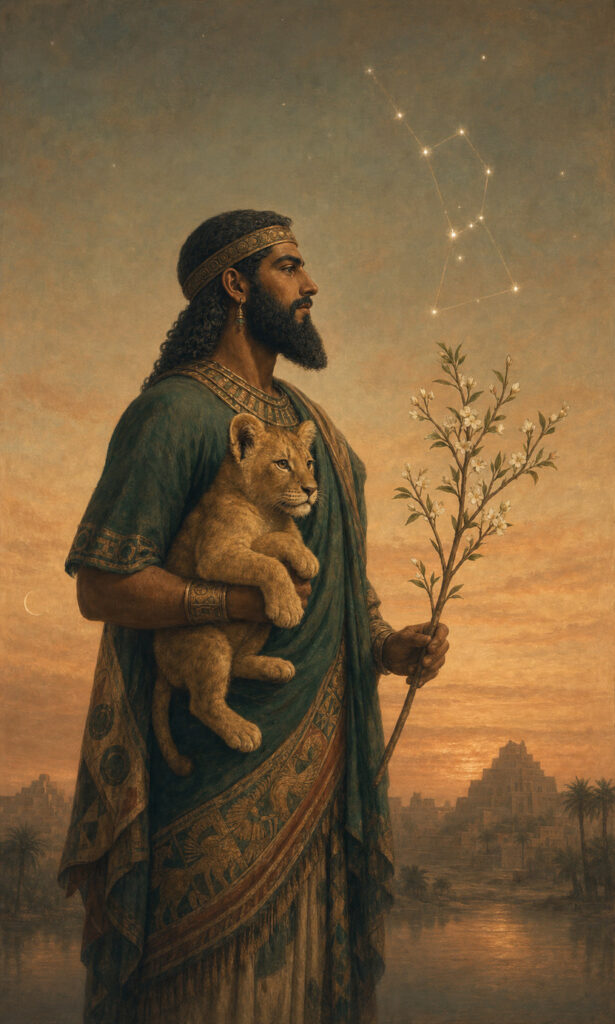
In the previous essay, I followed Zacchaeus into the fig tree and explored it as an image of an inner axis: the place from which a person begins to stand within their own life. Now I turn towards a related image, the figure I contemplate as Nimrod, with a lion beneath one arm and a flowering branch in the other.
What draws me is the relationship between the figure and the animal. I do not see only the drama of pursuit; I see the possibility of carrying something powerful without being ruled by it.
From that point, Nimrod becomes more than a distant ancestral hero in my reading. He becomes an inward question: can I learn to bear my own strength without continually fighting it?
The lion-bearing figure and the flowering branch belong here to a symbolic composition. I am not presenting them as an archaeologically authenticated portrait of the biblical Nimrod, or claiming that an ancient inscription identifies the figure in precisely this way.
Veronika Marton’s interpretation of a cylinder seal is one of the starting points acknowledged in my original exploration. (The Hungarian Soul4you essay) The reading I develop here is my own, and its central concern is the inward relationship between strength and care.
Several portraits, different kinds of story
Genesis presents Nimrod as a mighty figure and describes him as “a mighty hunter in the eyes of the LORD”, associating the beginnings of his kingdom with cities in Shinar. (Genesis 10:8–12, NABRE) That biblical portrait is not something my symbolic reading needs to erase.
A different layer appears in Hungarian chronicle tradition: Simon of Kéza names Ménrót as the father of Hunor and Magor, placing their story within an account of the origins of the Huns and Hungarians. (Simon of Kéza, Gesta Hungarorum, Hungarian translation hosted by ELTE) A medieval origin narrative and a modern account of ancestry are different kinds of claim.
Even the historical identification of the biblical figure requires care: the NABRE note proposes a possible connection with the Assyrian ruler Tukulti-Ninurta I, rather than treating the identification as certain. (Note on Genesis 10:8) I do not need to settle that question in order to explore an image.
My question is not which community has preserved the only true Nimrod. It is what becomes visible when I read the figure as a quality of inner life.
What if a name that usually points towards a person could also become a way of recognising a state within us? Not a new etymology, but another use of the story.
Seven ways into the image
As in the reflection on Zacchaeus, I follow seven points of attention. They are not seven pieces of evidence proving a hidden ancient code; they are seven ways of approaching the pattern I see.
The name as an inward question
I begin by setting aside, for a moment, the demand to decide exactly who Nimrod was. What happens if I ask what the name evokes in me?
In this essay, Nimrod can name a capacity: to stand with strength without turning strength into domination. I use the name in that symbolic sense, not as a claim that its original language literally means a spiritual rank.
The lion that is carried
The particular inward image that stays with me is a lion held close. I read that gesture as a changed relationship with power: the animal is neither denied nor allowed to take over.
What once seemed too dangerous to acknowledge can perhaps be met with steadiness. That is the movement I call carrying.
The flowering branch
In the image I contemplate, the branch is alive. It suggests growth rather than a weapon, something to tend rather than something with which to strike.
It also brings the Hungarian double cross to mind as a visual association. I do not take that resemblance as proof that one symbol historically developed from the other.
For this reading, the branch becomes a small image of the tree of life. It joins rootedness and openness, earth beneath and sky above.
The lion as the heart’s strength
I use the lion for an inner quality I call royal consciousness: the capacity to inhabit one’s strength with dignity and responsibility. “Royal” here describes a manner of being, not noble ancestry or a higher value than another person.
The solar warmth, courage and awakened heart that I associate with the lion belong to this symbolic reading. I am not proposing one universal meaning shared by every culture that has depicted a lion.
The biblical lion
Revelation calls Christ “the lion of the tribe of Judah” and then presents the vision of a Lamb that seemed to have been slain. (Revelation 5:5–6, NABRE) Those images have their own place in the book’s account of Christ.
I hear a resonance with the question of strength, but I do not make Christ and Nimrod interchangeable. The connection I draw is narrower: power need not be understood only through force.
In my inner map, the lion is therefore not simply an enemy to defeat. It can become the strength with which I must learn to live.
The deer that changes the direction of the hunt
In Kéza’s account, Hunor and Magor pursue a deer that disappears in the marshes of Meótisz; their search brings them to land they later choose to inhabit. (Simon of Kéza, the deer episode) The story allows me to contemplate a pursuit whose meaning changes along the way.
What if what I follow is not something to possess, but something that leads me somewhere I could not yet imagine?
That is how the deer becomes a guide in my reading. The intended destination gives way to a different kind of discovery.
Orion and a wider horizon
Orion enters this essay as part of the symbolic constellation I bring to Nimrod. I use the stars as an image of orientation: a way to look beyond the immediate story of who I think I am.
I am not using astronomy to establish spiritual ancestry, or claiming that a constellation transmits a particular quality to one nation. The cosmic dimension of this reading concerns belonging to a wider whole, not possessing a privileged origin.
What interests me is the change of scale. A person who has lived only inside a narrow account of their own limitations may begin to imagine a larger setting for their life.
The tree-bearer
Now the elements come together in my reading. The lion is strength, the flowering branch is living growth, and the figure holds both without having to turn them against each other.
This is what I mean by the tree-bearer. Not someone who has conquered every difficult part of themselves, but someone learning to sustain life within.
The distinction matters. I can spend years treating parts of myself as opponents, or begin asking what a responsible relationship with them would look like.
In the symbolic language of these essays, Zacchaeus begins by finding his place in the tree. Nimrod carries the image further: the axis is no longer only something he approaches, but something he learns to bear.
That is an inward comparison, not a claim that the two narratives originally told the same story. What joins them for me is the movement from striving towards inhabiting.
There can be a moment when one’s own strength no longer feels like a blade turned inward. It becomes something that can be held with care.
Nimrod, in this reading, does not have to keep fighting the lion. He learns how to carry it.
Two lions and a tree
Another image helps me stay with this: two lions facing one another, with a tree between them. In my symbolic reading, the lions hold the tension of a pair, while the tree gives that tension an axis.
I might read the pair as action and receptivity, conscious intention and what has not yet become conscious, or earth and sky. These are ways I work with the image, not fixed meanings that I assign to every historical example.
The image matters to my relationship with Hungarian cultural memory. That personal connection does not require me to claim an uninterrupted line of transmission from ancient Mesopotamia, or to speak for every Hungarian person’s inner life.
What I see is a form of belonging that is held together by something living. Not only the sword, which separates and defends, but the tree, which roots, grows and shelters.
The question becomes intimate. What keeps my own life together: a continuing struggle against myself, or a centre that can hold different parts without erasing them?
A thread from Ágnes Golenya
I also bring this reflection into conversation with Purisaca Ágnes Golenya’s Hungarian trilogy A Kék Vér Gyermekei, whose volumes include Imhotep, a kékség papja, Az Isis-kód and Utazás az aranykorba. (The author’s presentation of the trilogy) The title may be rendered descriptively in English as “The Children of Blue Blood”; that is a translation of the Hungarian title, not the title of an English edition.
Her presentation of the third volume places it within a metaphysical account of humanity’s cosmic story. (Purisaca Ágnes Golenya, book descriptions) I approach that work as spiritual literature and as an influence on my reflection, not as evidence for a historical or astronomical claim.
The imagery of Orion, Sirius and a golden age belongs, for me, to this wider spiritual conversation. I hear in it an invitation to remember a way of being rather than acquire a superior identity.
When I bring “blue” or “royal” consciousness into this essay, I do not mean biological blood, inherited purity or a hierarchy of peoples. I mean the inner possibility of clarity, responsibility and a heart that no longer has to hide its strength.
The connection with Nimrod is my own. I am placing two symbolic languages in conversation, not declaring them identical.
Nor does this possibility depend on being chosen ahead of someone else. The invitation is available without a test of ancestry, nationality or status.
What might your lion be?
Here the image becomes personal. What is the strength you have found difficult to carry?
- Anger: Not permission to harm someone, but perhaps a signal that a boundary or a long-neglected need requires attention.
- Talent: An ability you have kept small because allowing it space felt too exposed.
- Leadership: The willingness to take responsibility without either disappearing or controlling everyone around you.
- Love or passion: Something deeply felt that asks for honesty, care and respect for the other person’s freedom.
- Inner discernment: A quiet recognition you want to examine seriously, without abandoning reflection or practical judgement.
Carrying the lion does not mean acting on every impulse. It means neither making an enemy of what you feel nor handing it complete control.
The tree-bearer’s next step may be outward: beginning a project, returning to a manuscript or speaking honestly in a relationship. It may also be almost invisible, a decision to stop treating a part of oneself with contempt.
I do not think this always happens quickly. Learning to carry strength can involve practice, support and the willingness to repair what we get wrong.
But the direction changes. Instead of asking only how to defeat myself, I can ask how to live with myself more truthfully.
Two questions to keep
You do not need to answer these immediately. Let them remain available for a quieter moment.
- What is your lion? What strength have you been suppressing, fearing or fighting, and what would it mean to carry it responsibly?
- Where could respect replace the inner hunt? What part of yourself might respond differently if you approached it with honesty and care?
The final essay in this three-part sequence turns towards cosmic consciousness and the possibility of remembering what has been forgotten. It brings the images of Zacchaeus’s tree and Nimrod’s lion into the same inward space.
For now, I would leave you with this image: the lion is already beneath your arm. You can stop the inner hunt and begin learning how to carry it.
With love,
Georgina
Soul4you