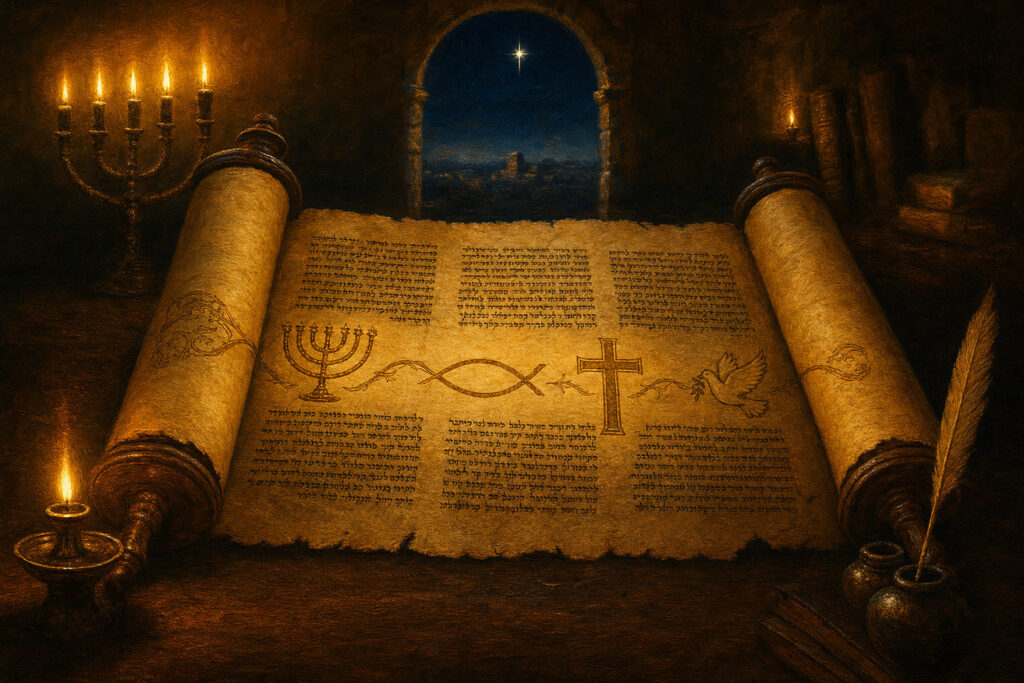
One dream, from the beginning to awakening
Soul4you · Georgina Kovacs
In an earlier reflection, we paused beneath a tree. I brought Eve’s reaching for the fruit and Zacchaeus’s upward movement into a single inward image: consciousness reaching out, then beginning to turn towards recognition.
Now I want to look at the wider path. What opens if I read the biblical stories as different movements within one unfolding experience of consciousness?
A Course in Miracles is the spiritual companion I have chosen for this reading. It describes Eden as a state before separation and draws attention to Adam’s sleep without an explicitly narrated awakening. (A Course in Miracles, T-2.I.3)
From that starting point, I develop the image of a single dream: separation, conflict, the beginning of choice, guidance and awakening. This is my metaphysical map, not a claim that the biblical writers or every religious tradition intended the same interpretation.
I am not asking the Bible to lose its place in anyone’s faith. I am asking what these stories may reveal when I also read them inwardly.
How to use this map
Two kinds of order appear below. The first follows selected biblical narratives through their settings; the second arranges them into the five inward threads of this series.
They are related, but they are not identical. A sequence of stories is not automatically a verified historical calendar, and the order in which I explore their meaning need not reproduce every stage of the narrative.
Traditional chronologies also use different dating schemes: two sources consulted for this overview place the events of Genesis 12 and Isaac’s birth in different sets of years. (Got Questions, Hungarian biblical timeline; A bibliai könyvek történeti idővonala) Rather than combine those schemes into a table of apparently certain dates, I use narrative settings here.
The tables are a guide to selected passages, not an exhaustive chronology. The links identify the biblical scenes; the inward meanings developed later are my readings of them.
The biblical sequence
The opening stories
| Narrative setting | Story and passage |
|---|---|
| The beginning | The six days of creation: Genesis 1 |
| The garden | The man, the garden and the command concerning the tree: Genesis 2 |
| Within the garden narrative | Adam’s deep sleep and the formation of the woman: Genesis 2:21–25 |
| The eating of the fruit | The serpent, the tree of knowledge and the departure from Eden: Genesis 3 |
| Life outside the garden | Cain and Abel: Genesis 4 |
| The flood narrative | Noah and the ark, beginning in Genesis 6 and continuing through Genesis 9 |
| The generations after the flood | The city and tower of Babel: Genesis 11:1–9 |
The ancestral narratives
| Narrative setting | Story and passage |
|---|---|
| Abram leaves Haran | The call and departure: Genesis 12 |
| Abraham’s lifetime | The destruction of Sodom and Gomorrah: Genesis 19 |
| Abraham and Sarah’s old age | Isaac’s birth: Genesis 21:1–7 |
| After Isaac’s birth; his age is not specified in this scene | Abraham and Isaac in Moriah: Genesis 22 |
| The next generation | The birth of Esau and Jacob: Genesis 25:19–26 |
| Jacob’s return towards Esau | The night at the Jabbok and the encounter at Peniel: Genesis 32 |
| Joseph’s youth | Joseph is taken to Egypt: Genesis 37 |
| Joseph’s later life in Egypt | Joseph reveals himself to his brothers: Genesis 45 |
Job belongs beside these stories in the thematic movement of my series, but I do not assign him a precise year or call him Abraham’s contemporary. The opening of Job places him in the land of Uz without giving a historical date or naming a ruler. (Job 1)
The exodus and the wilderness
| Narrative setting | Story and passage |
|---|---|
| Israel’s bondage in Egypt | The birth and early life of Moses: Exodus 2 |
| Moses in Midian | The burning bush and the divine name: Exodus 3 |
| The departure from Egypt | The plagues culminate in Passover and departure: Exodus 7–12, with Exodus 12 describing Passover |
| The escape from Pharaoh’s pursuit | The crossing of the sea: Exodus 14 |
| At Sinai | The commandments: Exodus 20 |
| While Moses is on the mountain | The golden calf: Exodus 32 |
| The wilderness journey | The bronze serpent: Numbers 21:4–9 |
| The entry into the land | The fall of Jericho: Joshua 6 |
Kings, prophets, exile and return
| Narrative setting | Story and passage |
|---|---|
| The establishment of the monarchy | Saul is chosen as king: 1 Samuel 8–10, culminating in 1 Samuel 10 |
| Saul’s reign | David and Goliath: 1 Samuel 17 |
| Solomon’s reign | The request for wisdom and the judgement between two women: 1 Kings 3 |
| Elijah’s prophetic ministry | Carmel and the journey to Horeb: 1 Kings 18–19, with the quiet encounter in 1 Kings 19 |
| Jonah’s prophetic story | The call to Nineveh, flight and eventual return to the task: Jonah 1–4, beginning in Jonah 1 |
| Babylonian domination of Judah | The siege and deportation under Jehoiachin: 2 Kings 24 |
| The end of Zedekiah’s reign | Jerusalem and the temple are destroyed: 2 Kings 25 |
| The narrative’s transition to Median and Persian rule | Daniel in the lions’ den: Daniel 6 |
| Cyrus’s proclamation | Permission to return and rebuild: Ezra 1 |
| The Persian court | Esther becomes queen under Ahasuerus: Esther 2, followed by the rest of her story |
Jesus and the early Christian community
The following selection moves from birth through ministry to the Passion, resurrection and the early community. It is not an attempt to give each Gospel episode an independently established calendar year.
| Narrative setting | Story and passage |
|---|---|
| Jesus’ birth and childhood | Bethlehem and the early years: Luke 2 |
| Before the public ministry in Matthew | The temptation in the wilderness: Matthew 4:1–11 |
| Jesus’ teaching ministry | The Sermon on the Mount: Matthew 5–7, beginning in Matthew 5 |
| Jesus’ teaching ministry | The parable of the lost son: Luke 15:11–32 |
| Before the final Passover in John | The raising of Lazarus: John 11 |
| The approach towards Jerusalem in Luke | Zacchaeus in Jericho: Luke 19:1–10 |
| Under Pontius Pilate | The crucifixion and burial: John 19 |
| After the burial | The empty tomb and appearances of the risen Jesus: John 20 |
| The early Christian community | Saul’s encounter on the road to Damascus: Acts 9 |
| John’s visionary setting on Patmos | The opening vision: Revelation 1 |
| The fulfilment portrayed in the vision | A new heaven and a new earth: Revelation 21 |
Three ideas from A Course in Miracles
Before turning this sequence into an inward map, I want to make the lens clear. The terms below belong to the Course’s metaphysical account; I am not presenting them as definitions shared by all readers of the Bible.
The dream of separation
The Course describes Eden as a condition before separation in which nothing was needed, and treats the experience of separation through the image of Adam’s sleep. (A Course in Miracles, T-2.I.3) In the interpretation I develop from this, the dream is the experience of having become separate from the Source.
That experience can feel like lack, conflict and the need to defend a fragile identity. The question is whether the conviction beneath it must remain unquestioned.
Forgiveness
The heading of Workbook Lesson 121 is “Forgiveness is the key to happiness.” (A Course in Miracles, W-121) The Course connects forgiveness with a way of seeing beyond the judgement that maintains separation. (A Course in Miracles, T-6.II.4–5)
In bringing that idea into daily life, I do not use it to deny harm, erase responsibility or tell someone to remain in danger. I ask whether an injury must become the final truth about either person.
A different way of seeing
Workbook Lesson 132 is headed “I loose the world from all I thought it was.” (A Course in Miracles, W-132) I understand the miracle, within the perspective of this series, as a change in how I see: the possibility of no longer giving fear the last word.
That is not a promise that every outward difficulty disappears when I change my mind. It is an invitation to reconsider the meaning from which I act.
For Soul4you, this is a movement towards responsibility rather than an escape from it. If I am dreaming, then I am the one who can begin to awaken.
The five inward threads
These threads are the structure of my reading, not a set of biblical commentaries contained in A Course in Miracles. The Course gives me a vocabulary for separation, correction and return; the correspondences between individual scenes and inner movements are the ones I explore in this series.
The beginning of the dream
The first thread asks how wholeness comes to be experienced as separation. Creation is the horizon of the map, not an event that I place after Adam’s sleep: the creation account precedes the garden narrative in the biblical text. (Genesis 1; Genesis 2)
| Biblical scene | The inward movement I explore |
|---|---|
| Creation | Wholeness before the conviction that something essential is missing. |
| Adam’s sleep | The beginning of experienced separation. |
| The serpent and the eating of the fruit | The promise that acquiring something outside myself will make me complete; a further movement into judgement. |
| Cain and Abel | A single mind experiencing itself as divided, then defending that division through attack. |
| The flood and the ark | The wish to begin again, and the possibility of something within us carrying life through upheaval. I use the ark as an image of Christ-consciousness, meaning awareness of shared wholeness, within this symbolic reading. |
| Babel | The effort to secure identity through what we build, and the fragmentation of communication that follows. |
The biblical flood narrative includes judgement and destruction; I am not claiming that those elements are absent from Genesis. (Genesis 6:5–22) My inward use of the ark asks a different question alongside the narrative: what carries the possibility of renewal when an entire familiar world seems to be breaking apart?
The birth of choice
The second thread turns towards the first conscious willingness to respond differently. I hear it as a movement from defending what I know towards listening for what I have not yet allowed.
| Biblical scene | The inward movement I explore |
|---|---|
| Abraham’s departure | The first yes to a call that does not provide a complete map in advance. |
| Abraham and Isaac | Trust examined at the point where love and possession can become confused. |
| Jacob’s struggle | The night in which a familiar identity can no longer hold everything that is being asked of it. |
| Joseph and his brothers | The possibility of meeting a shared past without making retaliation its only future. |
| Job’s losses and continuing story | The question of what remains when the structures through which I knew myself have fallen away. |
In Genesis 22, Isaac is not killed: the angel stops Abraham, and a ram is offered instead. (Genesis 22:11–14) My reading therefore does not turn harm to a child into a spiritual instruction.
Likewise, Job’s grief is not cancelled by the question of what remains. The opening narrative describes the loss of his children as well as his possessions; an inward reflection must not make those losses interchangeable or dismiss them as nothing. (Job 1:13–22)
Learning to follow guidance
The third thread asks whom I am listening to. It draws on the Course’s distinction between the voice we make and the guidance given by God. (A Course in Miracles, T-5.II.3)
| Biblical scene | The inward movement I explore |
|---|---|
| The burning bush | A call that interrupts habit and asks for a response. |
| The crossing of the sea | The passage from a familiar captivity towards a freedom I do not yet know how to inhabit. |
| The golden calf | The wish to make certainty visible and possessable. |
| The bronze serpent | Turning towards what has become an image of fear, rather than assuming that avoidance is the only response. |
| Elijah at Horeb | Listening beyond the force and noise I may mistake for authority. |
| Jonah’s flight and return | The resistance that appears when a call does not agree with my preferred direction. |
Numbers describes recovery when those bitten look towards the bronze serpent; that narrative is not a general instruction that looking at a frightening image will cure illness. (Numbers 21:4–9) Here I am considering its symbolic place within an inward journey.
At Horeb, the narrative distinguishes the divine encounter from wind, earthquake and fire, and describes what follows as a light, silent sound. (1 Kings 19:11–13) The question I take from it is not whether silence always supplies an answer, but whether I am willing to listen without demanding that guidance arrive as force.
Awakening
The fourth thread brings the figure and teachings of Jesus to the centre of my reading. I explore awakening here as recognition of a relationship with the Source that the dream of separation has obscured.
| Biblical scene | The inward movement I explore |
|---|---|
| Jesus’ birth | The beginning of a recognised Christ-presence within my own life. |
| The temptation in the wilderness | Refusing to ground identity in display, domination or the demand for proof. |
| The Sermon on the Mount | A life whose inward orientation becomes visible in the way it meets others. |
| The lost son | Return met by welcome, rather than by the rejection the returning person may fear. |
| The raising of Lazarus | An image through which I contemplate life beyond the limits I have assumed. |
| Zacchaeus in the tree | A changed position from which to see, followed by the willingness to come down and respond. |
| The crucifixion | The question of whether attack must determine the whole meaning of an encounter. |
| The resurrection | Awakening as the breaking of an apparently final boundary. |
| Saul on the road to Damascus | An interruption of certainty that changes the direction of a life. |
These inward correspondences do not exhaust the Christian meanings of incarnation, crucifixion and resurrection. They describe what I am exploring through the Course, not what another reader must stop believing.
In the Lazarus story, Jesus first speaks of sleep, then explicitly says that Lazarus has died. (John 11:11–14) The metaphor should deepen the reading, not replace the actual wording with a denial of the narrative.
The tree connection also remains symbolic. Genesis does not identify the species of the tree whose fruit is eaten, while Luke names the tree Zacchaeus climbs as a sycamore. (Genesis 3; Luke 19:4) I bring the two movements together as an inward image, not as a botanical identification.
The completion of the movement
The final thread draws on the vision of a new heaven and a new earth, where God dwells with humanity and tears are wiped away. (Revelation 21:1–4) In my reading, this is the image of belonging no longer experienced through exile.
I contemplate it as a return to the wholeness represented by Eden, now recognised. This is an inward reading of fulfilment, not a claim that Revelation has no other religious or future-oriented meaning.
A tree, a dream, an awakening
Read through the map once more, not to memorise every scene, but to notice the movement. Something grasps, something fears, something fights, something listens.
Then a different response becomes possible. The person I had made into an enemy is no longer only that image; the uncertainty I feared is no longer only a threat.
Within the metaphor of this series, every figure can become a place of recognition. I can find something of Cain, Abraham, Jacob or Jonah in the ways I defend, leave, struggle and resist.
This does not make other people mere objects in my private story. The point of reading inwardly is to become more responsible in relationship, not less.
The Course introduces another perspective on the whole movement: Lesson 158 describes the journey as already completed, though experienced as if its future were still unknown. (A Course in Miracles, W-158.3–4) I take this as a metaphysical perspective on time, not a claim established by physics.
From within the dream, there appears to be a path. From the perspective of wholeness, I contemplate the possibility that nothing essential has been lost.
Holding those two perspectives together does not ask me to skip the next step. It changes the fear with which I approach it.
Where the map meets your life
You do not need to recognise yourself in every story. Begin with the one that stays with you.
- Where, like Cain, have you tried to diminish something because its presence made you uncomfortable?
- Where, like Abraham, have you responded to a call without seeing the whole route?
- Where, like Jacob, have you struggled with an identity that no longer fits?
- In a time of loss, what has helped you remain present without pretending that the loss did not matter?
- Where, like Zacchaeus, have you needed a different place from which to see?
These are questions, not diagnoses. A story may accompany you without supplying a complete explanation of your experience.
For me, the possibility of awakening begins with a willingness to notice how I am seeing. I do not have to condemn myself for having been afraid in order to choose differently.
Two notes for the reader
Passover and the resurrection
One traditional chronology consulted for this overview places Jesus’ resurrection in AD 30, but this map does not depend on choosing a precise year for the Passion and resurrection narratives. (A bibliai könyvek történeti idővonala) Its purpose is to make the narrative sequence and my inward reading clear.
Passover and Christian Easter must not be treated as interchangeable names for the same event. Exodus 12 places Passover in the story of Israel’s deliverance from Egypt, while John presents Jesus’ death in the setting of Passover and then narrates the empty tomb and appearances of the risen Jesus. (Exodus 12; John 19; John 20)
The relationship between the narratives is important to this reading. Respecting that relationship also means respecting their differences.
Biblical references and Course references
I use the English biblical book names in the passage links, including Genesis, Exodus and Revelation. For A Course in Miracles, T refers to the Text, W to the Workbook for Students, and the numbers identify the cited chapter, section, paragraph or lesson as shown on the linked text pages.
The tables of inward correspondences are my synthesis. They should not be read as a list of statements that the Course makes about each biblical character.
An invitation, not a final system
This article offers a map, not an exclusive interpretation. I place the Bible and A Course in Miracles in conversation because their encounter opens something within my own way of seeing.
The invitation is not to exchange one unquestionable framework for another. It is to notice whether a story can help you become more honest, more loving and more awake to your own choices.
The tree remains an image of that possibility. We can pause beside it, look again, and take the next step.
With love,
Georgina
Soul4you