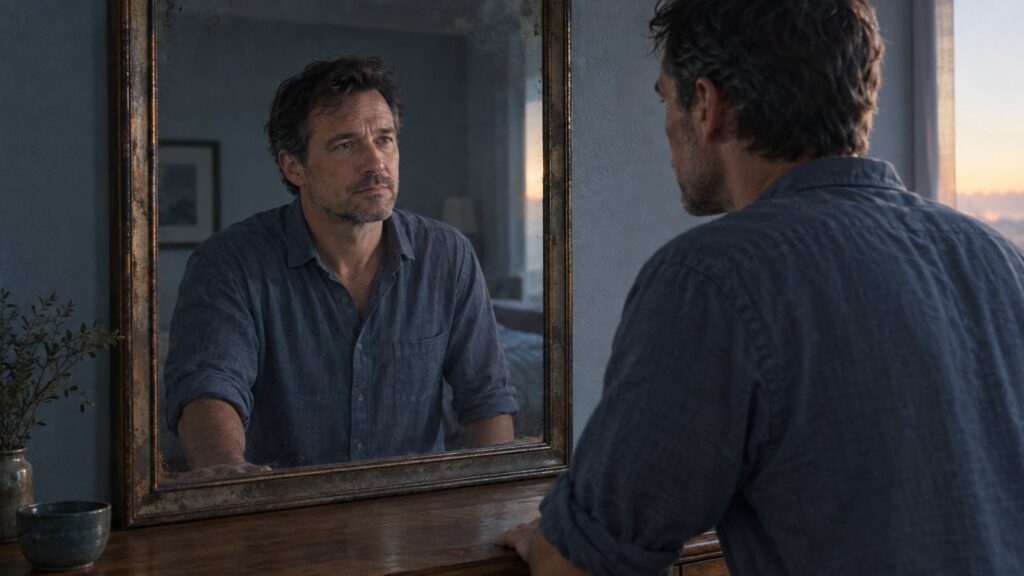
A night with an unknown opponent, and a question about the struggle within
Soul4you · Georgina Kovacs · The Birth of Choice, Part 3
The previous reflection explored Isaac’s story through the question of offering and drawing near. The biblical account holds a difficult tension between the command concerning a burnt offering and the later command not to harm the boy. (Genesis 22:2, 12) I carry the question of trust forward from that tension, rather than setting the difficulty aside.
Now we arrive at a river crossing in the night. Here, the image is not of someone climbing a mountain, but of someone wrestling with a stranger until daybreak.
Imagine not knowing the face of the person before you. You cannot tell whether this encounter will end in defeat, release or something you do not yet have a name for. In Jacob’s story, the night ends with a blessing, a new name and a limp. (Genesis 32:25–32)
I read this encounter as a possible map of inner struggle. That is my metaphysical reading, offered alongside the narrative and its religious interpretations, not as a replacement for them. The question I bring is this: what changes when the struggle is no longer only about winning?
The crossing where Jacob is left alone
Jacob is preparing to meet Esau, the brother whose blessing he obtained through deception. He learns that Esau is approaching with four hundred men, and the prospect frightens him. (Genesis 27; Genesis 32)
During the night, Jacob brings his two wives, the two maidservants, his eleven children and his possessions across the Jabbok. The narrative then narrows its attention to one man. (Genesis 32:23–25)
“Jacob was left there alone. Then a man wrestled with him until the break of dawn.” (Genesis 32:25, NABRE)
For me, that narrowing is important. The people and possessions that surround a life have crossed to the other side, and the story pauses with the person who remains.
I do not read this as a command to strip ourselves of relationships or support. Solitude need not mean abandonment. Here, it gives me an image of the moment when my usual roles cannot answer the question for me.
Who am I when I cannot explain myself through what I own, whom I care for or what others expect me to be? What is waiting for my attention when there is no familiar task to hide behind?
What the wrestling text does, and does not, say
The narrative calls Jacob’s opponent a man, while Rashi’s commentary brings in the rabbinic identification of the figure as Esau’s guardian angel. (Genesis 32:25; Rashi on Genesis 32:25) My inward reading sits alongside that religious interpretation, without trying to settle the figure’s identity for everyone.
The Hebrew wrestling verb, commonly transliterated vaye’aveq, has prompted more than one explanation. Rashi records Menachem’s association with dust, then offers his own explanation through an Aramaic expression for attaching or embracing, describing the close bodily contact of wrestling. It would therefore be too simple to say that the Hebrew word unambiguously means both dust and struggle. (Rashi on Genesis 32:25)
What stays with me is the closeness of the encounter. Wrestling is not something done from a safe distance. You cannot hold the other person at arm’s length in the way you might hold an argument or an opinion.
Within my inward reading, the stranger becomes a question about what Jacob is meeting in himself. The encounter gives me an image through which to explore a struggle that is also taking place within.
It allows me to ask whether a conflict can contain more than its visible participants. Alongside the real person before me, am I also struggling with fear, shame, memory or the need to be proved right?
Why the hip matters in this reading
The narrative locates the injury at Jacob’s hip socket and later describes him limping. It tells us where he is hurt and how he leaves the encounter; it is not a clinical account from which to draw conclusions about the safety or exact consequences of such an injury. (Genesis 32:26, 32)
I read the injured hip as an image of interrupted self-reliance. The part of the body through which Jacob stands and moves is no longer available to him in the same way. The encounter has touched his capacity to continue as before.
That symbolism does not mean that illness or disability is a spiritual failure. Nor does it mean that an injury is sent to prevent someone escaping a lesson. Those would be claims I cannot responsibly make from this story.
The question is quieter: where does my usual way of moving through life become difficult? Where have I relied on the same response for so long that I no longer notice I am relying on it?
Perhaps I withdraw whenever I feel misunderstood. Perhaps I explain myself until there is no room left to listen. Perhaps I make myself useful before anyone can ask who I am.
The image of the hip invites me to notice the habit without condemning the person who developed it. Something that once helped me survive may now need to be understood rather than endlessly repeated.
“I will not let you go until you bless me”
As daybreak approaches, Jacob asks for something unexpected:
“I will not let you go until you bless me.” (Genesis 32:27, NABRE)
Rashi reads the request in relation to the blessing Jacob received from his father and Esau’s objection to it. Jacob is seeking its acknowledgement, not merely a new advantage won in a contest. (Rashi on Genesis 32:27)
My own inward reading takes a further step. I hear the possibility of moving from grasping at a blessing to standing openly before it. What was once sought through disguise might now be received without having to become someone else.
In this application, the blessing also opens a question about forgiveness. What happens when self-recognition becomes more important than self-justification?
Imagine a person lying awake after a difficult conversation. They turn over the same words, pick up their phone, put it down again. They want to explain what the other person failed to understand.
Then, perhaps, something else becomes visible. There is the real disagreement, but there is also the old fear of not mattering. There is the other person’s behaviour, but there is also the familiar need to leave the conversation as the one who was right.
The disagreement has not magically disappeared. Yet the person now knows a little more about what they are carrying into it.
For me, this is one possible blessing within struggle: not that pain was necessary, but that understanding became possible. It is not a reason to remain in danger, tolerate abuse or postpone help; stepping away can be the wisest way to honour what has become clear.
The name he can finally say
The stranger asks Jacob his name, and Jacob answers with his own. Earlier, when his father asked who he was, he claimed to be Esau. The contrast between those two answers is present in the narrative. (Genesis 32:28; Genesis 27:18–19)
This time, there is no borrowed identity in the answer. In my reading, that is a threshold: I cannot meet myself honestly while insisting on being someone else.
The response is:
“You shall no longer be named Jacob, but Israel, because you have contended with divine and human beings and have prevailed.” (Genesis 32:29, NABRE)
Genesis connects Jacob’s earlier name with grasping his brother’s heel and, in Esau’s later complaint, with being supplanted. (Genesis 25:26; Genesis 27:36) The new name, Israel, receives its narrative explanation through the struggle and prevailing described in this verse; these wordplays are the starting point for my reflection. (Genesis 32:29 and its notes)
What interests me is the movement between the names. There is an old way of securing a place, and there is the possibility of inhabiting that place more openly.
A new understanding does not erase a life already lived. I do not have to pretend that I never grasped, feared or concealed myself in order to begin responding differently now.
Dawn at the edge of the struggle
Dawn marks the approaching end of the encounter. Rashi explains the opponent’s request to be released through the angel’s duty to sing praise at daybreak. That is a specific traditional reading, distinct from the symbolism I draw from the light. (Genesis 32:25, 27; Rashi on Genesis 32:27)
For me, dawn is a fitting image because it is neither the full darkness of night nor the settled visibility of day. Something has become possible to see, although not everything is clear.
Inner understanding can arrive like that. There is not always a triumphant moment when the whole pattern is explained. Sometimes there is only a small recognition, sufficient to change the next response.
I may still feel hurt. I may still need a boundary or an apology. Yet I no longer have to confuse that need with the demand that the other person confirm my whole worth.
That is the dawn I am interested in. Not the denial of darkness, but the first light by which I can see what I have been holding.
Peniel: meeting face to face
Jacob names the place Peniel and speaks of seeing God face to face while his life has been spared. The name and explanation belong to his account of the encounter. (Genesis 32:31)
I do not want to reduce that religious claim to a psychological label. In the metaphysical perspective of this series, the encounter with oneself and openness to the divine can belong within the same inquiry, without being declared identical in every tradition.
Within the single-dream framework of this series, Jacob’s night becomes an encounter within the mind that is awakening. The apparent opponent brings the mind face to face with what it has struggled to recognise as its own. This is the metaphysical reading I bring to the narrative, rather than a claim that Genesis describes Jacob as asleep at the river.
The question it opens is personal rather than compulsory: what might I discover if I stopped meeting every difficult feeling as an enemy? Could I remain present long enough to distinguish the feeling from the story I have built around it?
That need not happen alone or all at once. Sometimes another person’s steady presence helps us look at what we could not safely approach by ourselves.
Leaving with a limp
The account does not end with an untouched victor:
“At sunrise, as he left Penuel, Jacob limped along because of his hip.” (Genesis 32:32, NABRE)
The following verse connects the incident with the Israelites’ avoidance of the sciatic muscle at the hip socket. This is part of the passage’s religious and communal meaning, not merely a detail to turn into an individual metaphor. (Genesis 32:33)
The verse describes Jacob at this point in the story, without establishing a lifelong injury; Rashi also preserves a reading in which the rising sun brings healing. (Genesis 32:32; Rashi on Genesis 32:32)
The image is powerful enough without making it permanent. A blessing and an unfinished recovery can be present together.
I may understand something and still need time. I may forgive and still feel grief. A moment of clarity does not oblige the body or the rest of life to catch up immediately.
To me, this is not a diminished ending. It is a compassionate one: the person who moves forward need not look untouched by what has happened.
Three ways to sit with the story
These are gentle reflections, not instructions to relive an overwhelming experience. Choose an ordinary, manageable situation, and stop if the exercise becomes too much.
- Name the struggle without enlarging it. Write down what is happening now, what another person has actually done, and what you fear it means about you. Keep those three things separate. You may discover a practical problem, an old interpretation, or both.
- Ask what needs to be understood. Instead of asking only how to win the argument, ask what you need to see clearly. This might reveal a feeling, a responsibility or a boundary. Understanding your part does not remove the other person’s responsibility.
- Allow an unfinished step. Think of one area where you expect yourself to be completely over something. What would a kind, realistic next step look like if you did not demand that all pain disappear first? Rest, support and distance are possible answers too.
The path beyond this night
The family story does not end at the river. Later, Joseph’s story will bring us to another form of struggle: betrayal, separation and the difficult possibility of meeting familiar people without being wholly governed by the past. (Genesis 37; Genesis 45)
The question will change. Here, I have asked what happens when someone stops hiding within the struggle. With Joseph, I turn first towards forgiveness: what happens when the past no longer determines how we meet the person before us?
Your own night at the river
Is there a struggle in which being right has become more important than understanding what hurts? Is there a name or role you feel you must keep defending?
What would it mean to speak more truthfully about yourself without turning that honesty into another accusation? And what support would help you do so?
Not every conflict is a conflict with ourselves. Yet sometimes, within a real difficulty, we meet a part of ourselves that has been waiting to be seen.
Perhaps that is where a blessing can begin. Not because we have won, and not because suffering has become good, but because we no longer have to meet ourselves only as an opponent.
Texts and reading notes
Biblical quotations follow the New American Bible, Revised Edition (NABRE); verse numbers follow that edition, which may differ from those in some English Bibles. The principal passage is Genesis 32:23–33, linked throughout the article.
Rashi’s comments are paraphrased and distinguished from my own symbolic applications. The inward and dream-based readings belong to this series; they are not presented as the only Jewish or Christian understanding of the passage.
The earth beneath my feet, the sky above my head, my heart in its rightful place.
With love,
Georgina
Soul4you