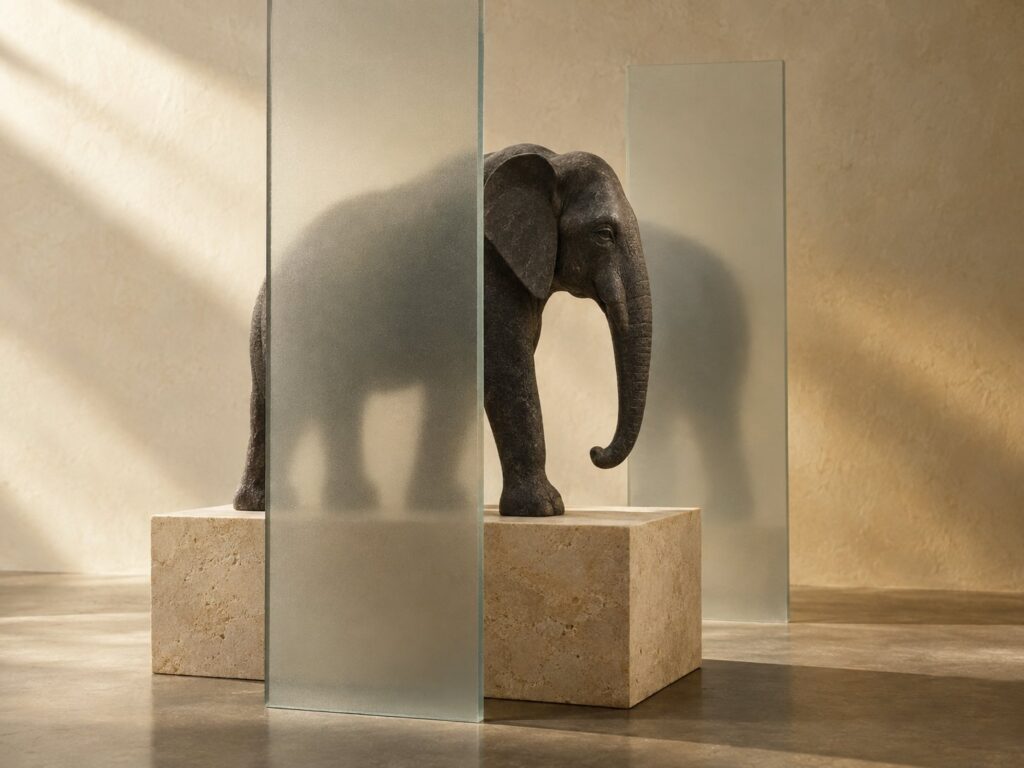
How certain can we be about our views on a situation? It is particularly worth asking this question when we feel there is nothing left to examine about it.
This reminds me of the Buddhist parable of the elephant and the blind men. At a ruler’s request, a group of men who have been blind since birth are asked to feel an elephant: one feels its ear, another its leg, yet another its trunk; and when they describe what the animal is like, each describes it differently, yet each insists that their own description is the whole truth. This parable appears in Udāna 6.4; I am briefly retelling it here in my own words, drawing on Ṭhānissaro Bhikkhu’s translation of Udāna 6.4.
For me, the most important thing about the story is not that the answers differ. It is that they all encountered something that truly belonged to the elephant, and yet they claimed more than what they had actually experienced: they identified the part with the whole.
What we know, and what we add
We rarely know everything about a new situation straight away. We hear about it from someone, read an article, watch a film, and then form a picture based on this information. In the process, we also choose who to listen to, which book to take off the shelf, and whose opinion to trust.
That in itself is not a problem. The question is rather whether we realise that our established perspective has its limits. Just because something seems familiar or convincing, there may still be details that we are unaware of.
It is therefore worth taking a closer look at the subject on which we are forming an opinion. What do I know about it first-hand? What do I know from what others have said? And what conclusions have I drawn from this?
A place for personal experience
I believe personal experience is important. It is one thing to read about a situation, and quite another to be there in the moment, to ask questions, to observe, and then to realise what actually emerges compared to our preconceived notions.
At the same time, in everyday situations, our own experience also arises from a particular perspective. It does not render other people’s knowledge superfluous, nor does it mean that we must experience everything personally in order to understand it. Rather, it gives us the opportunity to compare the knowledge we have acquired with what we observe for ourselves.
If the two images do not match, we do not necessarily have to choose between them straight away. We can ask ourselves first: what else do I need to understand this better?
The jigsaw puzzle never ends
To me, the understanding we build from details in everyday life is like a jigsaw puzzle. Each new piece not only adds to the picture, but sometimes also changes the way we see the pieces that are already in place.
We may never fully grasp the whole picture of a particular situation. However, this does not render the search meaningless: the fact that we still have questions can bring us closer to understanding something.
I am not, by this, questioning the possibility of spiritual certainty. I am talking about the limitations of our everyday perception and the explanations we derive from it: the fact that recognising a single detail does not mean we understand all the connections.
I believe this openness is important in self-knowledge too. We do not need to give up what we have recognised so far, but we can leave room for what may yet reveal itself.
Perhaps it’s worth adding a single sentence to our opinion from time to time: this is what I can see from here. And I’m also curious about what I can’t yet see from here.
With love,
Georgina
Soul4you