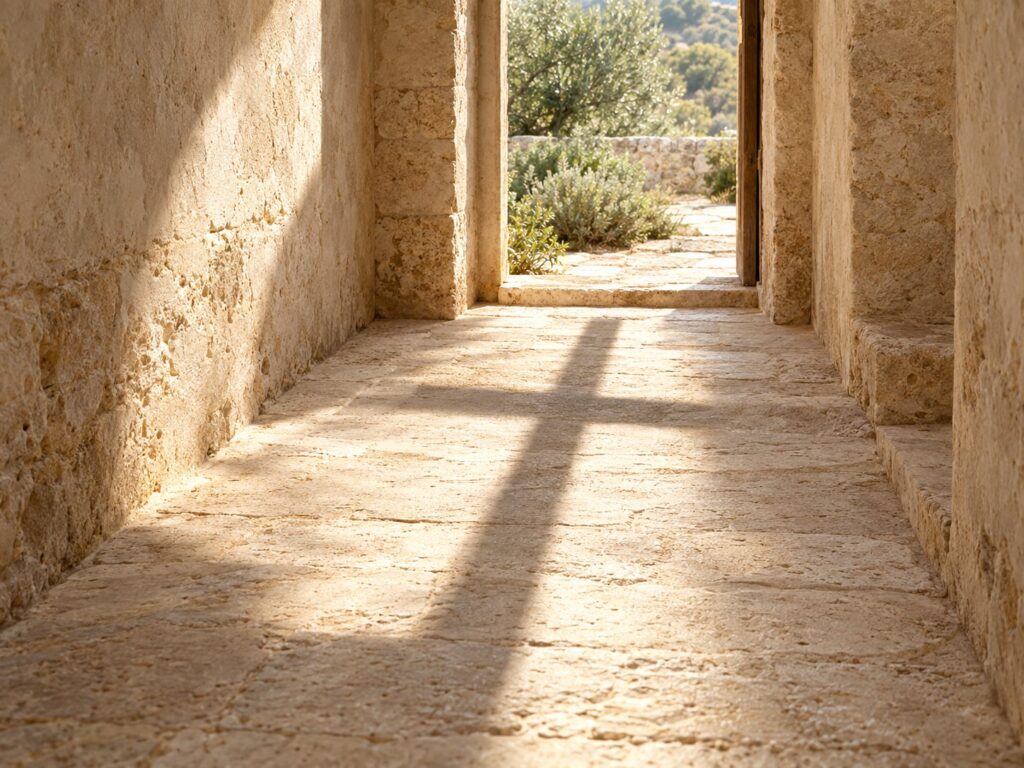
A guide can show us the way, but it cannot walk the path for us. For me, this question is also encapsulated in the cross: what do we do with the call when we can not only hear it, but also respond to it?
Forms and their inner meaning
The Hungarian Catholic Encyclopaedia describes Saint Anthony’s cross, also known as the tau cross, as T-shaped, whereas the vertical arm of the Latin cross extends above its horizontal arm (tau cross; Latin cross). The Egyptian ankh, or looped cross, is a symbol of life; Saint Peter’s cross is an inverted Latin cross associated with the tradition of Peter’s crucifixion (ankh; Saint Peter’s cross).
Looking at these forms may lead to our own insights. However, similarity alone does not prove a common origin, and I would not wish to draw conclusions about anyone’s spiritual state simply from the orientation of a symbol.
The name of the tau cross should not be confused with tao, also written dao, the ‘Way’ in Chinese philosophy (tau cross; tao). The image of a path remains a valuable parallel for me, provided I use it as a symbolic association, not as linguistic evidence.
The Place of the Skull: what do we do with understanding?
The Gospel of Matthew refers to the site of the crucifixion as Golgotha, meaning ‘The place of a skull’ (Matthew 27:33, World English Bible, British Edition). For me, this name also raises the question of understanding: what happens to the teaching that reaches our minds?
This is my own personal interpretation, not a historical explanation of the place name. For me, the heart is a gateway: we comprehend and unpack the realisation coming from the Source with our minds. The image of the head here signifies this comprehension, not that spiritual information would first reach the mind and only then the heart.
I can understand, for example, that another person is not there simply to carry out my plans. But accepting this in principle is different from letting go of the expectation that someone in my life should follow my vision at all costs.
For me, this is where teaching really comes to life. Not by explaining things more precisely, but by being present in a different way.
Salvation is not the transfer of responsibility
In my own spiritual interpretation, the crucifixion of Jesus does not mean that someone else has taken on responsibility for all our deeds, and that we no longer need to examine ourselves or change how we live. I say this not as a summary of others’ interpretations of salvation, but to clarify what I myself see in the cross.
For me, receiving help and accepting responsibility belong together. Relief from a burden does not remove the need to face our actions or to change how we live. I see the cross as a call to inner transformation, not a reason to leave our lives unexamined.
In the Gospel of Matthew, Jesus draws a distinction between listening to his teaching and putting it into practice: ‘Everyone therefore who hears these words of mine and does them, I will liken him to a wise man who built his house on the rock.’ (Matthew 7:24; see also 26–27, World English Bible, British Edition). For me, the emphasis here is not that someone else has already done everything for us, but that the teaching must become a reality in our own lives.
No one can undergo this inner transformation on our behalf
For me, salvation can only become a reality as an inner transformation experienced on a personal level. We may receive guidance, help and love, but no one else can recognise the truth on our behalf, make our decisions for us, or put into practice on our behalf what we have come to understand.
That is why neither following a teacher, nor knowing the teachings, nor invoking the name of Jesus can replace the work we do on ourselves. The question is whether a change takes place within us, and whether that change has an impact on the way we live.
Personal responsibility means that I must take responsibility for my own decisions, actions and inner work. I cannot pass this on to Jesus, nor can I carry out another person’s transformation on their behalf. We can help one another, but that help does not make our own involvement superfluous.
This does not mean that I am to blame for everything that happens to me, or that I am responsible for harm someone else has caused. It means that whatever I truly need to recognise, take responsibility for or make amends for cannot be dealt with by someone else on my behalf.
We do not have to earn God’s love through our works. However, being held in that love and living it out are not the same thing: we do not earn the first through achievement, and the second calls for our own participation.
Finding one’s way back, not building a new home
For me, this journey is not the struggle of a person who has been permanently cut off from God to find their way back to a foreign place. Rather, it is the realisation that the connection has not ceased simply because we have forgotten about it.
Here, I am following the image of sleep and awakening. Separation feels real in the state in which we live, but I do not regard this as the ultimate truth of our existence. The cross can thus be a symbol not only of hardship, but also of choice and remembrance.
Sometimes a decision may reinforce a sense of isolation, whilst at other times it may bring us closer to love. This is not determined by the shape of a cross or by a person’s external circumstances, but by the direction we choose to take within it.
For me, this is the essence of the journey: not to receive all the answers ready-made, but to connect ever more sincerely with whatever is guiding me. Will my next step reinforce the old sense of separation, or make room for a realisation of our interconnectedness?
With love,
Georgina
Soul4you