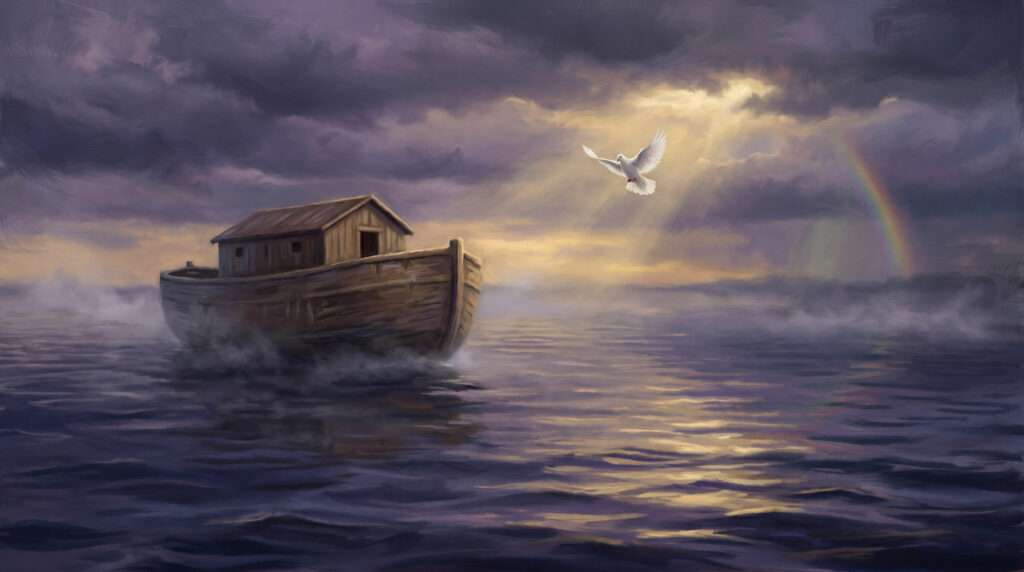
The third story: destruction within the dream
Soul4you · Georgina Kovacs · Part 3 of the One Dream series
In the first essay, I read Adam’s deep sleep as the beginning of a dream. In the second, Cain and Abel became an image of the sleeping mind turning against itself.
Now comes a third movement. The mind can no longer bear the world of conflict it has made within itself, and everything seems to break open at once.
This is the inward flood I explore here. I use Genesis as the narrative and A Course in Miracles as one of the frameworks through which I contemplate it; the resulting interpretation is my own.
The distinction matters because Genesis explicitly presents God as announcing the destruction. (Genesis 6:5–7, 13–17) My reading of a Source that does not seek to punish is not a correction of a mistranslated verb or a claim that the passage secretly says the opposite.
I am placing two different spiritual accounts in conversation. What emerges is an inward map, not the only meaning of the biblical story.
The deep breaks open
Genesis begins with darkness over the deep, and the flood account later describes the fountains of the great deep breaking open. (Genesis 1:2; Genesis 7:11) The Hebrew word tehom refers to the deep or depths, including the primeval ocean and subterranean waters. (Strong’s H8415 and Brown–Driver–Briggs)
That recurrence invites me to see the flood as an undoing of order. What had been held within boundaries returns as something overwhelming.
The word tehom does not literally mean the unconscious or the inner waters of a sleeping mind. That is the image I bring to it.
Think of an inward life that has depended on keeping everything in separate compartments. Anger belongs elsewhere, grief can wait, fear must not be named.
For a while, the arrangement may seem to hold. Then an event, perhaps small in itself, arrives at a point where there is no room left.
What follows can feel larger than that one event. In my symbolic reading, this is the breaking open of the deep.
I am not suggesting that every period of distress is caused by suppressed feelings. Some situations are overwhelming because what is happening outside us is genuinely too much.
The inward question becomes useful only when it does not erase that reality. What is happening around me, what is happening within me, and what support do I need for both?
Divine grief and an unchanging Source
Genesis describes human wickedness and God’s grief over having made humanity. (Genesis 6:5–6) The narrative speaks of God through recognisable human emotions.
A Course in Miracles presents a different metaphysical account: God’s will is changeless, and peace belongs to our reality in God. (Text, chapter 8, IV.1) I do not pretend these formulations are identical.
Instead, I ask what happens when I read the flood through the Course’s view of separation. In that reading, an image of a condemning God can become a projection of the mind’s own judgement.
The inward voice says: what I have become is unbearable. Then it imagines that this must also be the Source’s verdict.
This is my application of the Course’s discussion of projection, which describes the mind disowning what it does not want and perceiving it as belonging elsewhere. (Text, chapter 6, II.1–3) It is not a quotation in which the Course interprets Noah or explains a physical flood.
For me, the spiritual turning begins when I stop assuming that the harshest judgement within me must be God’s voice. What if the wish to erase everything comes from the conflict of the dream, not from the Source of life?
That question does not make us responsible for disasters, abuse or everything that happens to us. I am describing an inward relation to guilt, not a theory that victims create the harm they suffer.
Noah: the possibility of steadiness
Genesis introduces Noah as a person who finds favour with God and describes him as righteous within his generation. (Genesis 6:8–9) His name is associated with rest. (Strong’s H5146, Noach)
Noah is therefore a named character in the narrative, not a word that ceases to be a person’s name because it can carry an inward association. In my reading, that association allows him also to become an image of steadiness.
There is something within the scene that does not answer chaos with more chaos. It listens, prepares and builds.
In the biblical account, God gives the instructions and Noah carries them out. (Genesis 6:14–22) Symbolically, I connect that willingness to listen with the relationship to an inner teacher.
This does not mean that a calm part of us can foresee every crisis. Nor does it mean that anyone who becomes overwhelmed has failed to listen.
For me, the image asks a practical question: what can be built before everything is resolved? What might help carry life through uncertainty rather than demand that uncertainty disappear first?
An honest conversation, a dependable routine, prayer, a safe place or professional care may become part of that answer. The ark need not be built from inward resources alone.
The ark and what it carries
The Hebrew tevah is used for Noah’s vessel and for the basket in which the infant Moses is placed; it is not the word used for the Ark of the Covenant. (Strong’s H8392 and Brown–Driver–Briggs) These are two narrative settings for the word, not only two occurrences in the Bible.
The connection draws my attention to something small enough to be vulnerable and strong enough to carry life through danger. I contemplate the ark as a structure of protection rather than an instrument of conquest.
It does not defeat the water. It makes passage possible.
In the language of this series, that can become an image of the way guidance works. It does not have to begin by removing every circumstance; it may begin by helping us respond without abandoning what needs protection.
But a change of perspective is not a guarantee that real danger has ended. When safety requires action, the action belongs inside the spiritual life, not outside it.
Forty days, and the time a change takes
Genesis says that the rain falls for forty days and forty nights, but the narrative’s full period of flooding, waiting and emergence is much longer. (Genesis 7:12, 24; Genesis 8:3–14) Forty days must not be mistaken for the length of the whole episode.
I read the period of rain as an image of transition. It is not a timetable for emotional recovery or a code by which every difficult experience can be calculated.
There can be a particular cruelty in demanding that we be finished with something by tomorrow. The demand makes the unfinished state feel like another failure.
The ark offers me a different image. There is work to do while the destination is not yet visible, and staying with that work is not the same as standing still.
Patience, however, is not passivity. Waiting for an inward process to unfold should never mean postponing urgent care, tolerating abuse or refusing practical help.
Sometimes the next movement is rest. Sometimes it is a phone call, a decision or a departure.
I would rather ask what this day requires than force every stage of a life into an imagined schedule of awakening. The time we need is not evidence against us.
The raven, the dove and the olive leaf
The raven in Genesis goes back and forth until the waters have dried; the text does not simply say that it flies away and never returns. (Genesis 8:6–7) I therefore do not make it a factual illustration of feelings that can be sent away permanently.
In my reading, its movement can suggest searching without yet settling. There is activity, but not necessarily arrival.
The dove is sent out and returns when it finds no place to rest; Noah reaches out and brings it back into the ark. (Genesis 8:8–9) That small gesture is important to me.
Something has tried to go out before the conditions allow it, and it is received back. Not blamed, not pushed away, not told that returning means it has failed.
After seven more days, the dove returns with a freshly plucked olive leaf; after another seven days, Noah sends it out again, and it does not return. (Genesis 8:10–12) The signs come in stages.
I do not need to turn those intervals into a universal numerological law to hear the rhythm. Life is becoming possible, and the evidence is small before it is complete.
This is how I contemplate corrected perception: not an instant declaration that everything is well, but a growing capacity to notice what is actually present. The leaf does not mean there was no flood.
The dove also recalls the Gospel image of the Spirit descending like a dove at Jesus’ baptism. (Matthew 3:16) I draw a symbolic connection between those scenes, not a claim that Genesis identifies Noah’s dove as the Holy Spirit.
For me, both images invite attention to a presence that need not arrive through force. The sign may be quiet enough to overlook.
The rainbow and remembrance
After Noah’s offering, Genesis again acknowledges the inclination of the human heart towards evil, but places that acknowledgement beside a resolve not to repeat the destruction of every living thing. (Genesis 8:20–22) I find the change in the narrative’s direction striking.
The covenant that follows includes Noah, his descendants and every living creature, with the rainbow as its sign. (Genesis 9:8–17) Its promise concerns a flood destroying all flesh, not the disappearance of every future flood or danger.
God’s remembering is part of the language of that covenant. (Genesis 9:15–16) Within my own metaphysical reading, the rainbow becomes a reminder that the Source is not seeking my destruction.
Here again, I am not saying that this is the only meaning of the covenant. I am bringing its image into the inward journey of the series.
The flood has not been erased from the story. Something else now stands beside its memory.
That is also how I approach forgiveness: not as pretending that nothing happened, but as the possibility that what happened need not govern every future moment. The past may become less imprisoning without becoming harmless.
Continuing pain does not prove that forgiveness was false. Grief and memory do not have to disappear on command in order for a changed relationship with the past to be real.
The rainbow, for me, is not a certificate that I have completed the work. It is an image of a relationship that remains possible within it.
Three ways to bring the image into daily life
Build an ark you can actually use
Identify one source of steadiness before you need to rely on it completely. It might be a friend you can contact, a place where you feel safe, a brief practice, a notebook or appropriate professional support.
If life feels overwhelming, ask what has accumulated and what is happening now. You do not need to decide that it all comes from within you before asking for help.
Allow time without abandoning action
Instead of demanding that you resolve everything immediately, ask what one useful movement is possible today. Rest and practical action can both belong to that movement.
If an expectation or a role no longer serves you, you may begin to loosen it. You do not have to release a difficult memory before you are ready simply to satisfy the symbolism of the story.
Look for a sign without inventing a gift
When it feels safe to look back, ask whether your relationship with a difficult event has changed at all. Perhaps you can name it more accurately, protect yourself better, or accept support you could not accept before.
You are not required to find a benefit in the event itself. What matters is whether something life-giving is possible now.
The movement that continues
In this series, the flood marks the point at which the dreaming mind can no longer contain its conflict. The ark, the dove and the rainbow allow me to imagine another response: protection, patient attention and remembrance.
The next story is Babel, where the wish to build a name becomes another movement of the same mind. Before going there, I want to remain with the quieter image of a hand reaching out to receive a returning dove.
What has been your ark during an overwhelming time? Is there anything you can recognise now as a small sign of life, without denying what was difficult?
You do not have to see the whole shore. It may be enough to know what will support the next honest step.
With love,
Georgina
Soul4you