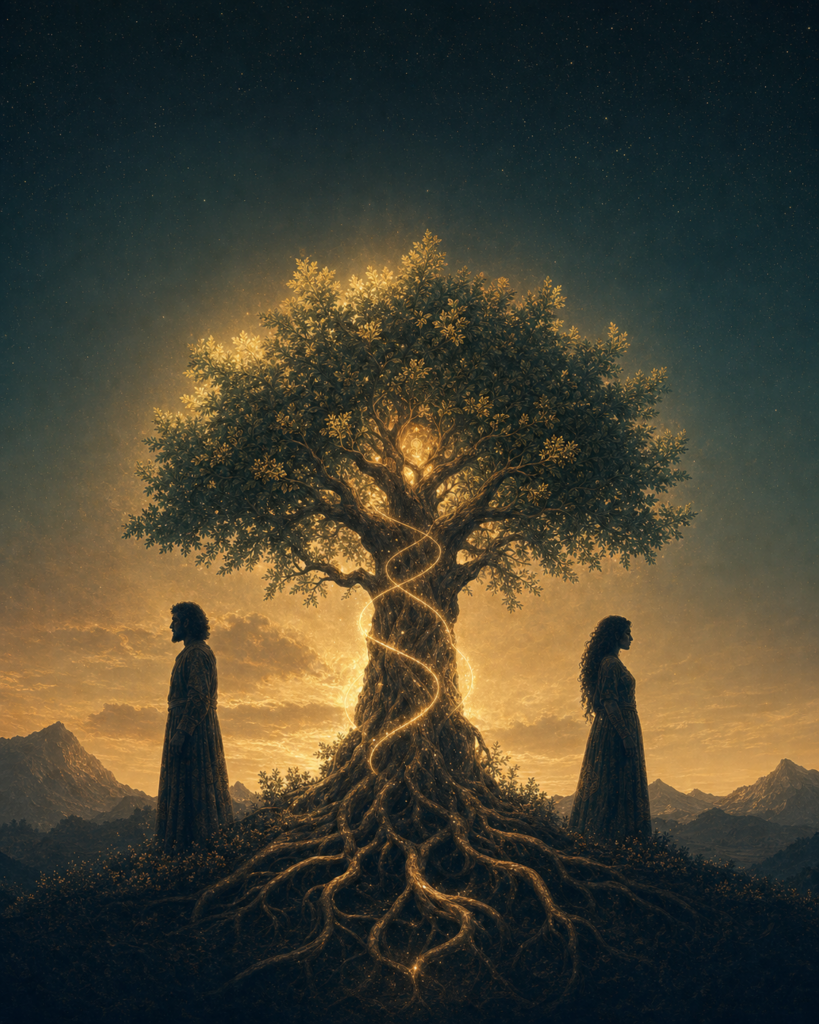
Knowing, judging and the movement towards the Source
Soul4you · Georgina Kovacs · Part 5 of the One Dream series
After Babel, I return to the garden. This is not the chronological order of Genesis; it is the inward order of the questions I am following.
The builder of the tower wanted to establish a name. At the tree, I look at a related movement: the wish to possess the measure by which everything can be named, divided and judged.
What happens when the mind turns knowledge into a means of separation? And what would it mean to know without standing apart from everything we seek to know?
These are the questions of my own metaphysical reading. The Hebrew text, A Course in Miracles and the symbolic connections I make will remain distinct, even where I bring them into conversation.
The words of the tree
Genesis places the tree of life in the garden and also names the tree of the knowledge of good and evil. (Genesis 2:9) The latter expression brings together the Hebrew words for tree, knowledge, good and evil.
I want to look at those words without making them say more than their range permits. A dictionary can help us attend to the text, but it cannot supply an entire spiritual system by itself.
Etz: tree
Etz is a word for a tree and for wood in a range of uses. (Strong’s H6086) The image of a tree connecting earth and sky is a symbolic possibility I contemplate, not a complete lexical definition.
For me, a tree offers an axis: rooted below, open above. The image allows me to ask how the same life can become either an object to control or a relationship in which to participate.
Da’at: knowledge
Da’at has a broad range that includes knowledge, understanding, discernment and skill. (Strong’s H1847 and Brown–Driver–Briggs) It should not be defined as always excluding information or always meaning mystical union.
The related verb yada can also be used for intimate relations, as in Genesis’ description of Adam knowing Eve. (Genesis 4:1) That use makes the language of knowing richer, but it does not determine the meaning of every occurrence of da’at.
Within my own reflection, I am especially interested in participatory knowing. What is the difference between describing a relationship from the outside and actually living it?
That is the spiritual question I bring to the word. It is not a claim that Hebrew vocabulary is identical to the specialised meaning of “knowledge” in A Course in Miracles.
Tov: good
Tov can describe what is good, pleasant, beneficial, fitting or morally right, according to context. (Strong’s H2896 and Brown–Driver–Briggs) Its ethical meanings should not be excluded in order to make room for a spiritual interpretation.
The repeated goodness of creation in Genesis gives me an image of recognition rather than competitive ranking. (Genesis 1) Something is received as good without first having to defeat something else.
I express that in my own language as being in its place, in relationship with its Source. That is an interpretation of the image, not the only translation of tov.
Ra: evil or bad
Ra can refer to moral evil, harm, adversity, unpleasantness or calamity, with its meaning depending on the passage. (Strong’s H7451 and Brown–Driver–Briggs) It would be misleading to say that it never carries a moral meaning.
In this essay, I contemplate the experience of what becomes harmful or disordered when we lose our sense of relationship. I do not use that reflection to make ethical distinctions disappear.
Cruelty does not become harmless because I am exploring a reality beyond division. An inward reading must still leave room to name what people do.
When the sleeping mind takes up the scales
The One Dream series begins from my symbolic use of Adam’s deep sleep. Genesis narrates that sleep, but the absence of an explicit waking sentence does not prove that the rest of the Bible takes place inside Adam’s dream. (Genesis 2:21–25)
The continuing dream is my interpretive framework. Within it, the tree becomes a question about what happens when a mind already experiencing separation reaches for knowledge.
The command warns against eating from the tree of the knowledge of good and evil and connects eating with death. (Genesis 2:16–17) Genesis later speaks of return to dust and exclusion from the tree of life, so mortality cannot simply be removed from the narrative. (Genesis 3:19, 22–24)
I therefore do not claim that the warning has nothing to do with physical death, or that the serpent’s denial is vindicated because the humans continue living after the meal. My essay asks about an additional inward meaning.
In my reading, death can also name an estrangement within living experience. Something that could have been encountered in relationship is taken up as a scale on which everything, including the self, must be weighed.
The tree is not, for me, an argument against learning. The problem is the position from which the mind seeks to know.
Does it want to participate in truth? Or does it want an instrument through which to secure its own superiority?
The distinction can be subtle. We may call something a search for knowledge while quietly hoping that it will make us unassailable.
The serpent’s promise
The serpent presents the fruit as a way for the humans’ eyes to be opened and for them to become like God in knowing good and evil. (Genesis 3:4–5) I hear in that promise an inward temptation to possess what can only be lived in relationship.
Within my framework, the longing beneath it is not contemptible. It is a longing for something the dreaming mind dimly remembers.
The distortion lies in the proposed movement: I will take this, make it mine, and establish myself through it. Connection is approached as acquisition.
The woman sees the fruit as good for food, desirable to the eyes and desirable for gaining wisdom; she eats and gives some to her husband. (Genesis 3:6) In this sequence, I contemplate the moment when longing becomes grasping.
That is not a judgement against women or a claim that one sex carries the blame for humanity’s condition. Both figures belong to the inward landscape I am reading.
The question can arise in any of us. Am I reaching for what is true, or for what I hope will make me secure against every uncertainty?
Opened eyes and a changed self-image
After eating, the man and woman recognise their nakedness and make coverings from fig leaves. (Genesis 3:7) The narrative gives me a striking image of a changed relationship with the self.
The body has not become a different body in that moment. What changes, in my reading, is the manner in which it is encountered.
The mind begins to divide: acceptable and unacceptable, presentable and shameful. Something once simply lived becomes something to assess and conceal.
I connect this, within my metaphysical framework, with a remaining memory of unity. A diminished account of myself can hurt partly because it does not correspond to what I believe I am at the Source.
That is my interpretation, not a psychological law proving that every instance of shame comes from a memory of spiritual wholeness. Actual humiliation and mistreatment also need to be recognised for what they are.
The inward possibility is that shame need not become identity. I can examine what I have done, or what has been done to me, without reducing my being to the most painful interpretation of it.
What is wrong with knowledge?
Nothing in my argument requires knowledge itself to be the enemy. What concerns me is the confusion between knowing and possessing a judgement.
A Course in Miracles distinguishes changing, interpretative perception from knowledge as timeless certainty. (Text, chapter 3, III.1–6) It also says that right-mindedness concerns corrected perception and should not be confused with the knowing mind. (Text, chapter 3, IV.4)
I bring those distinctions to the tree without claiming that they are the lexical meaning of da’at. The connection is philosophical and spiritual, not a translation equation.
For me, the judging mind stands apart and organises what it sees around itself. Direct knowing, in the metaphysical sense I am exploring, recognises a relationship that this division has obscured.
That does not mean that I should abandon judgement when choosing whom to trust, how to act or whether someone is safe. It means that practical discernment need not become a total verdict on the essence of a person.
I can know that an action was harmful without believing that the harm is the whole truth of the being who acted. I can recognise shared spiritual origin without offering access to someone who remains unsafe.
Leaving the garden
Genesis explicitly describes God sending the human out of the garden and guarding the way to the tree of life. (Genesis 3:22–24) I do not remove that action from the text by saying the passage contains only an impersonal psychological consequence.
In my own inward reading, however, expulsion also becomes the experience of estrangement. A mind organised entirely around separation does not experience the unity in which, I believe, its being remains grounded.
The distance is real as an experience, even if separation is not the ultimate reality in my metaphysical account. This is the tension the One Dream framework asks me to hold.
I cannot end it simply by announcing that I am already at home. I can begin by becoming willing to see differently.
Guénon and the limits of measuring
In The Reign of Quantity and the Signs of the Times, René Guénon criticises the reduction of qualitative reality to predominantly quantitative measures. (Chapters 1–3 and 7) His traditionalist framework is distinct from both Genesis and the Course.
I hear a resonance rather than an identity between them. The scales can weigh something, but weighing is not the only relationship we can have with it.
A relationship’s duration does not tell us everything about its quality. The number of ideas I can repeat does not establish how deeply I have lived any one of them.
Measurement has its place. The difficulty begins when I forget that it has a place and ask it to become the whole of knowing.
Images of life
In John’s Gospel, Jesus speaks of himself as the bread of life and, elsewhere, as the way, the truth and the life. (John 6:35; John 14:6) I contemplate those images beside the garden as a call towards participation rather than detached possession.
This does not make the New Testament a replacement for the Hebrew Bible or imply that Jewish tradition offers judgement while Christianity offers life. I am following a personal connection between particular images.
Bread is received and lived from. A way is travelled.
In my reading, the movement towards the Source is not the construction of a better spiritual ranking. It is a recovery of relationship.
Three small practices
Notice the scales
Pause when a judgement has become a complete account of yourself or another person. Ask what happened, what needs a response, and what additional verdict you have attached to it.
You do not have to suppress the judgement. You can notice it without making it final.
Allow a moment of participation
Take an ordinary moment: a sip of water, a comfortable breath, light entering a room. For a few seconds, let it be present without needing to compare or classify it.
I offer this as a small practice of attention, not as proof that you have entered the state called knowledge in the Course. The value lies in making room, not awarding yourself a spiritual level.
Recognise goodness without competition
Notice something you can receive as good without ranking it above something else. It may be a careful gesture, a living tree or a moment of honest contact.
For me, this is a way of contemplating tov: recognition of goodness without turning it into a weapon of comparison. It is an application inspired by the word, not its exclusive original meaning.
What follows the question of knowledge?
The tree brings me back to the movement beneath the earlier stories: the mind dividing, defending and trying to secure itself. In this series, that is the common thread I see in the conflict, the flood and the tower.
But recognising a pattern is not the same as returning home. A further question remains: how do we know that anything is missing?
The next essay follows that quieter thread through pain, shame and longing. For now, I leave the scales beside the tree and ask whether I can meet what is here without immediately trying to stand above it.
With love,
Georgina
Soul4you